


Page 252 - AJWEP-22-4
P. 252
Mohamed and Katambara


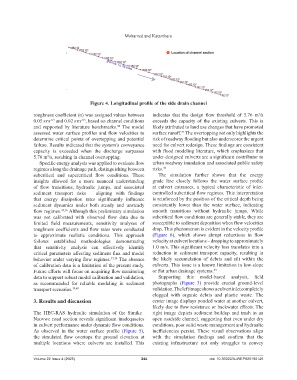
                                         Figure 4. Longitudinal profile of the side drain channel

                roughness coefficient (n) was assigned values between   indicates  that  the  design  flow  threshold  of  5.76  m /s
                                                                                                                   3
                0.05 sm  and 0.02 sm , based on channel conditions   exceeds  the  capacity  of  the  existing  culverts.  This  is
                                   .
                                     -1/3
                     .
                       -1/3
                and supported by literature  benchmarks.  The  model   likely attributed to land use changes that have promoted
                                                     34
                assessed  water  surface  profiles  and  flow  velocities  to   surface runoff.  The overtopping not only highlights the
                                                                                 41
                determine critical points of overtopping and potential   risk of roadway flooding but also underscores the urgent
                failure. Results indicated that the system’s conveyance   need for culvert redesign. These findings are consistent
                capacity  is  exceeded  when  the  discharge  surpasses   with flood modeling literature, which emphasizes that
                5.76 m /s, resulting in channel overtopping.        under-designed culverts are a significant contributor to
                      3
                  Specific energy analysis was applied to evaluate flow   urban roadway inundation and associated public safety
                regimes along the drainage path, distinguishing between   risks. 42
                subcritical  and  supercritical  flow  conditions.  These   The  simulation  further  shows  that  the  energy
                insights  allowed  for  a  more  nuanced  understanding   grade  line  closely  follows  the  water  surface  profile
                of  flow  transitions,  hydraulic  jumps,  and  associated   at  culvert  entrances,  a  typical  characteristic  of inlet-
                sediment  transport  risks  –  aligning  with  findings   controlled subcritical flow regimes. This interpretation
                that  energy  dissipation  rates  significantly  influence   is reinforced by the position of the critical depth being
                sediment  dynamics under both steady and unsteady   consistently  lower  than  the  water  surface,  indicating
                flow regimes. 35,36  Although this preliminary simulation   smooth  transitions  without  hydraulic  jumps.  While
                was  not  calibrated  with  observed  flow  data  due  to   subcritical flow conditions are generally stable, they are
                limited  field  measurements,  sensitivity  analyses  of   susceptible to sediment deposition when flow velocities
                roughness coefficients and flow rates were conducted   drop. This phenomenon is evident in the velocity profile
                to  approximate  realistic  conditions.  This  approach   (Figure  6),  which  shows  abrupt  reductions  in  flow
                follows  established  methodologies  demonstrating   velocity at culvert locations – dropping to approximately
                that  sensitivity  analysis  can  effectively  identify   1.0 m/s. This significant velocity loss translates into a
                critical  parameters  affecting  sediment  flux  and  model   reduction  in sediment  transport capacity, resulting  in
                behavior under varying flow regimes. 37,38  The absence   the  likely  accumulation  of  debris  and  silt  within  the
                of calibration data is a limitation of the present study.   culverts. This issue is a known limitation in low-slope
                Future efforts will focus on acquiring flow monitoring   or flat urban drainage systems. 43
                data to support robust model calibration and validation,   Supporting  this  model-based  analysis,  field
                as recommended for reliable  modeling in sediment   photographs (Figure  3) provide crucial  ground-level
                transport scenarios. 39,40                          validation. The left image shows a culvert inlet completely
                                                                    clogged  with  organic  debris  and  plastic  waste.  The
                3. Results and discussion                           center image displays ponded water at another culvert,
                                                                    likely due to flow resistance or backwater effects. The
                The  HEC-RAS  hydraulic  simulation  of  the  Simike–  right  image  depicts  sediment  buildup  and trash in an
                Nzovwe  road  section  reveals  significant  inadequacies   open roadside channel, suggesting that even under dry
                in culvert performance under dynamic flow conditions.   conditions, poor solid waste management and hydraulic
                As  observed  in  the  water  surface  profile  (Figure  5),   inefficiencies  persist.  These  visual  observations  align
                the  simulated  flow  overtops  the  ground  elevation  at   with  the  simulation  findings  and  confirm  that  the
                multiple  locations  where  culverts  are  installed.  This   existing  infrastructure  not  only  struggles  to  convey


                Volume 22 Issue 4 (2025)                       244                           doi: 10.36922/AJWEP025190146

