


Page 253 - AJWEP-22-4
P. 253
HEC-RAS study of Simike–Nzovwe drainage


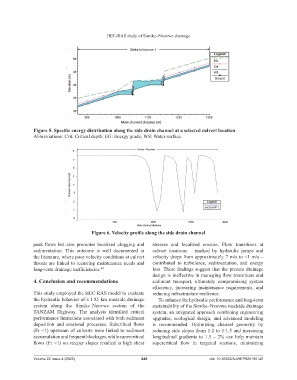
                Figure 5. Specific energy distribution along the side drain channel at a selected culvert location
                Abbreviations: Crit: Critical depth; EG: Energy grade; WS: Water surface.


                                         Figure 6. Velocity profile along the side drain channel

                peak  flows  but  also  promotes  localized  clogging  and   stresses  and  localized  erosion.  Flow  transitions  at
                sedimentation.  This  outcome  is  well  documented  in   culvert  locations  –  marked  by  hydraulic  jumps  and
                the literature, where poor velocity conditions at culvert   velocity drops from approximately 7 m/s to <1 m/s –
                throats are linked to recurring maintenance needs and   contributed  to  turbulence,  sedimentation,  and  energy
                long-term drainage inefficiencies. 44               loss. These findings suggest that the present drainage
                                                                    design is ineffective in managing flow transitions and
                4. Conclusion and recommendations                   sediment  transport,  ultimately  compromising  system
                                                                    efficiency,  increasing  maintenance  requirements,  and
                This study employed the HEC-RAS model to evaluate   reducing infrastructure resilience.
                the hydraulic behavior of a 1.85 km roadside drainage   To enhance the hydraulic performance and long-term
                system  along  the  Simike–Nzovwe  section  of  the   sustainability of the Simike–Nzovwe roadside drainage
                TANZAM  Highway.  The  analysis  identified  critical   system, an integrated approach combining engineering
                performance limitations associated with both sediment   upgrades, ecological  design, and advanced  modeling
                deposition  and  erosional  processes.  Subcritical  flows   is recommended. Optimizing channel  geometry  by
                (Fr <1) upstream of culverts were linked to sediment   reducing side slopes from 1:2 to 1:1.5 and increasing
                accumulation and frequent blockages, while supercritical   longitudinal gradients to 1.5 – 2% can help maintain
                flows (Fr >1) on steeper slopes resulted in high shear   supercritical  flow  in  targeted  sections,  minimizing


                Volume 22 Issue 4 (2025)                       245                           doi: 10.36922/AJWEP025190146

