


Page 90 - AJWEP-22-4
P. 90
Tran, et al.

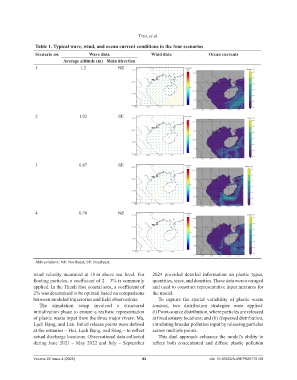
                 Table 1. Typical wave, wind, and ocean current conditions in the four scenarios
                 Scenario no.           Wave data                   Wind data                Ocean currents
                             Average altitude (m) Main direction
                 1                  1.2              NE


                 2                  1.02             SE


                 3                  0.87             SE


                 4                  0.78             NE


                 Abbreviations: NE: Northeast; SE: Southeast.

                wind velocity measured at 10 m above sea level. For   2024 provided  detailed  information  on plastic  types,
                floating particles, a coefficient of 2 – 3% is commonly   quantities, sizes, and densities. These data were averaged
                applied. In the Thanh Hoa coastal area, a coefficient of   and used to construct representative input mixtures for
                2% was determined to be optimal based on comparisons   the model.
                between modeled trajectories and field observations.   To  capture  the  spatial  variability  of  plastic  waste
                  The simulation setup involved  a structured       sources,  two  distribution  strategies  were  applied:
                initialization phase to ensure a realistic representation   (i) Point-source distribution, where particles are released
                of plastic waste input from the three major rivers: Ma,   at fixed estuary locations; and (ii) dispersed distribution,
                Lạch Bạng, and Lèn. Initial release points were defined   simulating broader pollution input by releasing particles
                at the estuaries – Hoi, Lạch Bạng, and Sùng – to reflect   across multiple points.
                actual discharge locations. Observational data collected   This  dual  approach  enhances  the  model’s  ability  to
                during June 2021 – May 2022 and July – September    reflect  both  concentrated  and  diffuse  plastic  pollution


                Volume 22 Issue 4 (2025)                        82                           doi: 10.36922/AJWEP025170129

