


Page 92 - AJWEP-22-4
P. 92
Tran, et al.

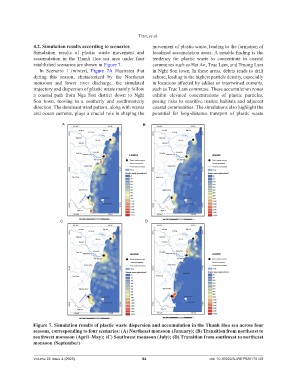
                4.2. Simulation results according to scenarios      movement of plastic waste, leading to the formation of
                Simulation  results of plastic  waste movement  and   localized accumulation areas. A notable finding is the
                accumulation  in the  Thanh Hoa sea area under four   tendency  for plastic  waste to concentrate  in coastal
                established scenarios are shown in Figure 7.        communes such as Hai An, Truc Lam, and Truong Lam
                  In Scenario 1 (winter),  Figure  7A illustrates  that   in Nghi Son town. In these areas, debris tends to drift
                during  this  season,  characterized  by  the  Northeast   ashore, leading to the highest particle density, especially
                monsoon and lower river discharge, the simulated    in locations affected by eddies or intertwined currents,
                trajectory and dispersion of plastic waste mainly follow   such as Truc Lam commune. These accumulation zones
                a coastal path from Nga Son district  down to Nghi   exhibit  elevated  concentrations  of  plastic  particles,
                Son town, moving in a southerly and southwesterly   posing risks to sensitive marine habitats and adjacent
                direction. The dominant wind pattern, along with waves   coastal communities. The simulations also highlight the
                and ocean currents, plays a crucial role in shaping the   potential  for long-distance  transport of plastic  waste

                            A                                   B


                            C                                    D


                Figure 7. Simulation results of plastic waste dispersion and accumulation in the Thanh Hoa sea across four
                seasons, corresponding to four scenarios: (A) Northeast monsoon (January); (B) Transition from northeast to
                southwest monsoon (April–May); (C) Southwest monsoon (July); (D) Transition from southwest to northeast
                monsoon (September)


                Volume 22 Issue 4 (2025)                        84                           doi: 10.36922/AJWEP025170129

