


Page 93 - AJWEP-22-4
P. 93
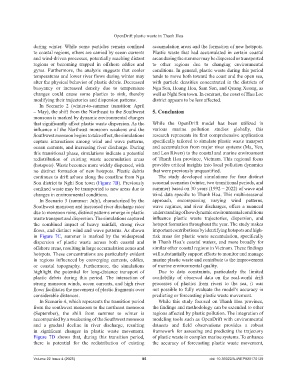
OpenDrift plastic waste in Thanh Hoa

                during  winter.  While  some  particles  remain  confined   accumulation areas and the formation of new hotspots.
                to coastal regions, others are carried by ocean currents   Plastic waste that had accumulated in certain coastal
                and wind-driven processes, potentially reaching distant   areas during the summer may be dispersed or transported
                regions  or  becoming  trapped  in  offshore  eddies  and   to  other  regions  due  to  changing  environmental
                gyres. Furthermore,  the analysis suggests that  cooler   conditions. In general, plastic waste during this period
                temperatures and lower river flows during winter may   tends to move both toward the coast and the open sea,
                alter the physical behavior of plastic debris. Decreased   with particle densities concentrated in the districts of
                buoyancy  or  increased  density  due  to  temperature   Nga Son, Hoang Hoa, Sam Son, and Quang Xuong, as
                changes  could  cause  some  plastics  to  sink,  thereby   well as Nghi Son town. In contrast, the coast of Hau Loc
                modifying their trajectories and dispersion patterns.  district appears to be less affected.
                  In Scenario  2 (winter-to-summer  transition:  April
                – May), the shift from the Northeast to the Southwest   5. Conclusion
                monsoon is marked by dynamic environmental changes
                that significantly affect plastic waste dispersion. As the   While  the  OpenDrift  model  has  been  utilized  in
                influence of the Northeast monsoon weakens and the   various  marine  pollution  studies  globally,  this
                Southwest monsoon begins to take effect, the simulations   research represents its first comprehensive application
                capture  interactions  among  wind and wave patterns,   specifically tailored to simulate plastic waste transport
                ocean currents, and increasing river discharge. During   and accumulation from major river systems (Ma, Yen,
                this transitional phase, simulations indicate a potential   and Len Rivers) to the coastal and marine environment
                redistribution  of  existing  waste  accumulation  areas   of Thanh Hoa province, Vietnam. This regional focus
                (hotspots). Waste becomes more widely dispersed, with   provides critical insights into local pollution dynamics
                no  distinct  formation  of  new  hotspots.  Plastic  debris   that were previously unquantified.
                continues to drift ashore along the coastline from Nga   The  study developed  simulations  for four distinct
                Son district to Nghi Son town (Figure 7B). Previously   seasonal scenarios (winter, two transitional periods, and
                confined waste may be transported to new areas due to   summer) based on 30 years (1992 – 2022) of wave and
                changes in environmental conditions.                wind data specific to Thanh Hoa. This multi-seasonal
                  In Scenario 3 (summer: July), characterized by the   approach, encompassing varying wind patterns,
                Southwest monsoon and increased river discharge rates   wave  regimes,  and  river  discharges,  offers  a  nuanced
                due to monsoon rains, distinct patterns emerge in plastic   understanding of how dynamic environmental conditions
                waste transport and dispersion. The simulations captured   influence  plastic  waste  trajectories,  dispersion,  and
                the  combined  impact  of  heavy  rainfall,  strong  river   hotspot formation throughout the year. The study makes
                flows, and distinct wind and wave patterns. As shown   important contributions by identifying hotspots and high-
                in  Figure  7C,  summer  is  marked  by  the  widespread   risk areas for plastic waste accumulation, specifically
                dispersion  of  plastic  waste  across  both  coastal  and   in Thanh Hoa’s coastal waters, and more broadly for
                offshore areas, resulting in large accumulation zones and   similar other coastal regions in Vietnam. These findings
                hotspots. These concentrations are particularly evident   will substantially support efforts to monitor and manage
                in  regions  influenced  by  converging  currents,  eddies,   marine plastic waste and contribute to the improvement
                or coastal topography. Furthermore,  the simulations   of marine environmental quality.
                highlight  the potential  for long-distance  transport of   Due to  data  constraints,  particularly  the  limited
                plastic  debris  during  this  period.  The  interaction  of   availability  of  observed  data  on  the  real-world  drift
                strong monsoon winds, ocean currents, and high river   processes  of  plastics  from  rivers  to  the  sea,  it  was
                flows facilitates the movement of plastic fragments over   not possible to fully evaluate the model’s accuracy in
                considerable distances.                             predicting or forecasting plastic waste movement.
                  In Scenario 4, which represents the transition period   While this study focused on Thanh Hoa province,
                from the southwest monsoon to the northeast monsoon   the findings and methodology can be extended to other
                (September),  the  shift  from  summer  to  winter  is   regions affected by plastic pollution. The integration of
                accompanied by a weakening of the Southwest monsoon   modeling tools such as OpenDrift with environmental
                and  a  gradual  decline  in  river  discharge,  resulting   datasets  and  field  observations  provides  a  robust
                in  significant  changes  in  plastic  waste  movement.   framework for assessing and predicting the trajectory
                Figure  7D shows that,  during this transition  period,   of plastic waste in complex marine systems. To enhance
                there  is  potential  for  the  redistribution  of  existing   the  accuracy  of  forecasting  plastic  waste  movement,


                Volume 22 Issue 4 (2025)                        85                           doi: 10.36922/AJWEP025170129

