


Page 106 - AJWEP-22-5
P. 106
Liu and Jusoh

                  Table 3 summarizes the themes and codes from this   to better adapt to market demands, improve the market
                section (Section 3.3). The main challenge lies in the low   acceptance  of recycled  materials,  and  enhance  their
                intrinsic value of recycled materials combined with high   economic viability.
                processing or sorting costs, resulting in poor economic
                viability.   Subsequently,  recycling  units  often  incur   3.4. Perspectives of government departments
                        26
                losses and face significant economic pressure. Although   In this section,  interviewees were invited  to discuss,
                these units help the government mitigate environmental   from the perspective  of government  departments,  the
                impacts,  they  often  do not  receive  corresponding   efforts made to allocate resources and provide technical
                economic  compensation.  Respondents explicitly     support for construction waste management, as well as
                                       27
                stated that the current selling price of recycled concrete   areas requiring improvement. This section emphasizes
                products is 10 – 20% lower than that of raw materials,   the  government’s  role  in  offering  economic  support
                further limiting profit margins. As a result, the income   (resources and technical  support) as a functional
                of  recycling  units  is  largely  driven  by  government   authority. The interviews in this section aimed to offer
                subsidies, making economic sustainability a key issue   a comprehensive understanding of the government’s
                restricting  the development  of recycling  enterprises.   current  support within  the  sample  region,  while
                This situation is also regarded as a key economic issue   identifying  shortcomings  and  areas  for improvement.
                restricting the development of recycling units. 28  These insights will help guide future strategies to
                  Regarding the obstacles, the main problems include   enhance  the  effectiveness  of  construction  waste
                a lack of trust in the quality of recycled products, low   management initiatives.
                pricing due to intense competition, and high disposal   By  analyzing the  theme-coding  table  of the
                costs leading to illegal dumping, which in turn causes   government department, as shown in Table 4, several key
                instability in waste sources. This was clearly reflected   findings  emerge.  First,  government  departments  have
                in R4’s statement, “The market demand for certain toxic   undertaken a series of supportive initiatives to promote
                wastes is low, the profits are minimal, and due to weak   the  recycling  of construction  waste.  These  included
                regulations, most contractors resort to illegal dumping   assisting in the formulation of more specific recycling
                to  avoid  disposal  costs,  further  limiting  the  profits.”   and classification guidelines, providing education and
                Therefore, ensuring a stable source of waste has also   training, offering special financial support, subsidizing
                become  an important  means to secure the economic   the costs of dedicated recycling vehicles, and supporting
                foundation of recycling companies. 29               the  construction of recycling centers.  In addition,  to
                  Finally, the recycler respondents discussed key areas   strengthen  the  supervision of the  recycling  process,
                for improvement, primarily aimed at promoting a healthy   several projects have introduced new technologies such
                and virtuous market cycle. These included certifications
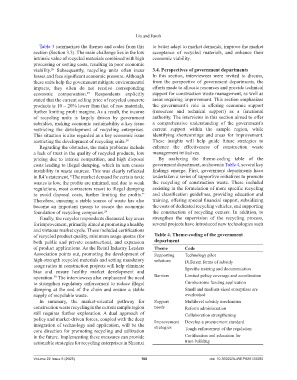
                of recycled product quality, minimum usage quotas (for   Table 4. Theme‑coding of the government
                both public and private construction), and expansion   department
                of product applications. As the Retail Industry Leaders   Theme   Code
                Association points out, promoting the development of   Supporting   Technology pilot
                high-strength recycled materials and setting mandatory   solutions  Different forms of subsidy
                usage ratios in construction projects will help eliminate
                bias and ensure healthy market development  and                   Specific training and documentation
                operation.  The interviewees also emphasized the need   Barriers  Limited policy coverage and coordination
                         30
                to strengthen regulatory enforcement to reduce illegal            Cumbersome funding application
                dumping  at  the  end of the  chain  and ensure a stable          Small and medium-sized enterprises are
                supply of recyclable waste.                                       overlooked
                  In summary, the  market-oriented  pathway  for     Support      Multilevel subsidy mechanism
                construction waste recycling in the current sample region   needs  Reform administration
                still  requires  further  exploration. A  dual  approach  of      Collaboration strengthening
                policy and market-driven forces, coupled with the deep   Improvement   Develop a procurement standard
                integration of technology and application, will be the   strategies
                core direction for promoting recycling and utilization            Tough enforcement of the regulation
                in the future. Implementing these measures can provide            Certification and education for
                actionable strategies for recycling enterprises in Shaanxi        trust-building


                Volume 22 Issue 5 (2025)                       100                           doi: 10.36922/AJWEP025120080

