


Page 105 - AJWEP-22-5
P. 105
Economic analysis: Shaanxi waste recycling

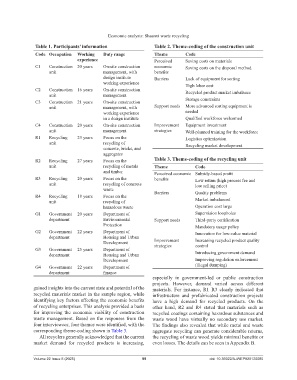
                 Table 1. Participants’ information                  Table 2. Theme‑coding of the construction unit
                 Code Occupation   Working     Duty range            Theme         Code
                                   experience                        Perceived     Saving costs on materials
                 C1    Construction  20 years  On-site construction   economic     Saving costs on the disposal method
                       unit                    management, with      benefits
                                               design institute      Barriers      Lack of equipment for sorting
                                               working experience                  High labor cost
                 C2    Construction  16 years  On-site construction                Recycled product market imbalance
                       unit                    management
                 C3    Construction  21 years  On-site construction                Storage constraints
                       unit                    management, with      Support needs  More advanced sorting equipment is
                                               working experience                  needed
                                               in a design institute               Qualified workforce welcomed
                 C4    Construction  20 years  On-site construction   Improvement   Equipment investment
                       unit                    management            strategies    Well-planned training for the workforce
                 R1    Recycling   23 years    Focus on the                        Logistics optimization
                       unit                    recycling of                        Recycling market development
                                               concrete, bricks, and
                                               aggregates
                 R2    Recycling   27 years    Focus on the          Table 3. Theme‑coding of the recycling unit
                       unit                    recycling of metals   Theme             Code
                                               and timber            Perceived economic  Subsidy-based profit
                 R3    Recycling   20 years    Focus on the          benefits          Low return (high process fee and
                       unit                    recycling of concrete                   low selling price)
                                               waste                 Barriers          Quality problems
                 R4    Recycling   18 years    Focus on the
                       unit                    recycling of                            Market imbalanced
                                               hazardous waste                         Operation cost large
                 G1    Government  20 years    Department of                           Supervision loopholes
                       department              Environmental         Support needs     Third-party certification
                                               Protection                              Mandatory usage policy
                 G2    Government  22 years    Department of                           Innovation for low-value material
                       department              Housing and Urban
                                               Development           Improvement       Increasing recycled product quality
                 G3    Government  25 years    Department of         strategies        control
                       department              Housing and Urban                       Introducing government demand
                                               Development                             Improving regulation enforcement
                 G4    Government  22 years    Department of                           (illegal dumping)
                       department              finance
                                                                    especially  in  government-led  or public  construction
                                                                    projects.  However,  demand  varied  across  different
                gained insights into the current state and potential of the   materials.  For instance,  R1–R3 clearly  indicated  that
                recycled materials market in the sample region, while   infrastructure  and  prefabricated  construction  projects
                identifying key factors affecting the economic benefits   have  a high demand  for recycled  products. On the
                of recycling enterprises. This analysis provided a basis   other hand, R2 and R4 stated that materials  such as
                for improving  the  economic  viability  of construction   recycled coatings containing hazardous substances and
                waste management. Based on the responses from the   waste wood have virtually  no secondary use market.
                four interviewees, four themes were identified, with the   The findings also revealed that while metal and waste
                corresponding theme-coding shown in Table 3.        aggregate recycling can generate considerable returns,
                  All recyclers generally acknowledged that the current   the recycling of waste wood yields minimal benefits or
                market demand for recycled products is increasing,   even losses. The details can be seen in Appendix B.


                Volume 22 Issue 5 (2025)                        99                           doi: 10.36922/AJWEP025120080

