


Page 109 - AJWEP-22-5
P. 109
Economic analysis: Shaanxi waste recycling


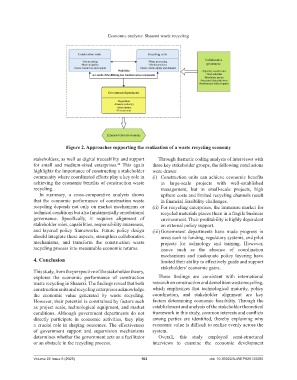
                              Figure 2. Approaches supporting the realization of a waste recycling economy


                stakeholders, as well as digital traceability and support   Through thematic coding analysis of interviews with
                for small  and medium-sized  enterprises.  This  again   three key stakeholder groups, the following conclusions
                                                     44
                highlights the importance of constructing a stakeholder   were drawn:
                community where coordinated efforts play a key role in   (i)  Construction units can achieve economic benefits
                achieving the economic benefits of construction waste   in large-scale  projects  with well-established
                recycling.                                              management,  but  in small-scale  projects,  high
                  In summary, a  cross-comparative  analysis  shows     upfront costs and limited recycling channels result
                that  the  economic  performance  of  construction  waste   in financial feasibility challenges.
                recycling depends not only on market mechanisms or   (ii)  For recycling enterprises, the immature market for
                technical conditions but also fundamentally on relational   recycled materials places them in a fragile business
                governance.  Specifically,  it  requires  alignment  of   environment. Their profitability is highly dependent
                stakeholder roles, capabilities, responsibility awareness,   on external policy support.
                and layered policy frameworks. Future policy  design   (iii) Government  departments have made  progress in
                should integrate these aspects, strengthen collaborative   areas such as funding, regulatory systems, and pilot
                mechanisms,  and transform the  construction  waste     projects for technology and training.  However,
                recycling process into measurable economic returns.     issues such as the  absence  of coordination
                                                                        mechanisms  and  inadequate  policy  layering  have
                4. Conclusion                                           limited their ability to effectively guide and support
                                                                        stakeholders’ economic gains.
                This study, from the perspective of the stakeholder theory,
                explores the economic  performance  of construction    These  findings  are  consistent  with  international
                waste recycling in Shaanxi. The findings reveal that both   research on construction and demolition waste recycling,
                construction units and recycling enterprises acknowledge   which emphasizes  that  technological  maturity, policy
                the economic  value generated  by waste recycling.   coordination,  and stakeholder alignment  are key
                However, their potential is constrained by factors such   factors determining economic feasibility. Through the
                as project scale, technological equipment, and market   establishment and analysis of the stakeholder theoretical
                conditions. Although government  departments  do not   framework in this study, common interests and conflicts
                directly  participate  in economic  activities,  they play   among  parties  are  identified,  thereby  explaining  why
                a crucial role in shaping outcomes. The effectiveness   economic value is difficult to realize evenly across the
                of government  support and  supervision  mechanisms   system.
                determines whether the government acts as a facilitator   Overall, this study employed semi-structured
                or an obstacle in the recycling process.            interviews to examine the economic development


                Volume 22 Issue 5 (2025)                       103                           doi: 10.36922/AJWEP025120080

