


Page 137 - AJWEP-22-5
P. 137
Climate trend and policy in Lake Tana Basin


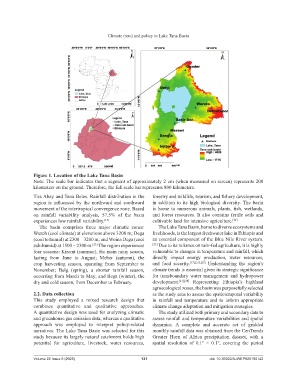
                Figure 1. Location of the Lake Tana Basin
                Note: The scale bar indicates that a segment of approximately 2 cm (when measured on screen) represents 200
                kilometers on the ground. Therefore, the full scale bar represents 800 kilometers.

                Tiss Abay and Tana Beles. Rainfall distribution in the   forestry and wildlife, tourism, and fishery development,
                region  is  influenced  by  the  northward  and  southward   in  addition  to  its  high  biological  diversity. The  basin
                movement of the intertropical convergence zone. Based   is  home  to  numerous  animals,  plants,  fish,  wetlands,
                on  rainfall  variability  analysis,  57.5%  of  the  basin   and  forest  resources.  It  also  contains  fertile soils and
                experiences low rainfall variability. [13]          cultivable land for intensive agriculture. [24]
                  The  basin  comprises  three  major  climatic  zones:   The Lake Tana Basin, home to diverse ecosystems and
                Wurch (cool climate) at elevations above 3200 m; Dega   livelihoods, is the largest freshwater lake in Ethiopia and
                (cool to humid) at 2300 – 3200 m; and Woina Dega (cool   an essential component of the Blue Nile River system.
                sub-humid) at 1500 – 2300 m.  The region experiences   [25]  Due to its reliance on rain-fed agriculture, it is highly
                                          [23]
                four seasons: Kiremt (summer), the main rainy season,   vulnerable to changes in temperature and rainfall, which
                lasting from June to  August; Meher (autumn), the   directly impact energy production, water resources,
                crop  harvesting  season, spanning  from  September  to   and food security. [17],[21],[26]   Understanding  the  region’s
                November; Belg (spring), a shorter rainfall  season,   climate trends is essential given its strategic significance
                occurring from March to May; and Bega (winter), the   for transboundary water management and hydropower
                dry and cold season, from December to February.     development. [27],[28]   Representing  Ethiopia’s  highland
                                                                    agroecological zones, the basin was purposefully selected
                2.2. Data collection                                as the study area to assess the spatiotemporal variability
                This study employed  a mixed  research  design that   in rainfall and temperature and to inform appropriate
                combines quantitative  and qualitative  approaches.   climate change adaptation and mitigation strategies.
                A quantitative design was used for analyzing climatic   The study utilized both primary and secondary data to
                and greenhouse gas emission data, whereas a qualitative   assess rainfall and temperature variabilities and spatial
                approach was employed  to interpret  policy-related   dynamics.  A  complete and accurate set of gridded
                narratives. The Lake Tana Basin was selected for this   monthly rainfall data was obtained from the CenTrends
                study because its largely natural catchment holds high   Greater Horn of  Africa precipitation dataset, with a
                potential  for agriculture,  livestock,  water  resources,   spatial  resolution  of 0.1° × 0.1°, covering the  period


                Volume 22 Issue 5 (2025)                       131                           doi: 10.36922/AJWEP025190142

