


Page 138 - AJWEP-22-5
P. 138
Messel, et al.

                1900 – 2023. Monthly temperature data were sourced   distribution, frequent missing data, and relatively short
                from the Climate Research Unit (CRU)  Time Series   observation periods.
                (TS) dataset, with a 0.5° × 0.5° resolution, spanning   To assess the spatiotemporal  variability  of rainfall
                1901 – 2022. Both CenTrends and CRU datasets were   and temperature in the Lake Tana sub-basin, data from
                obtained through the Royal Netherlands Meteorological   eight meteorological stations – Debre Tabor, Injibara,
                Institute  (Koninklijk  Nederlands  Meteorologisch  Gondar, Merawi,  Woreta,  Delgi, Bahir Dar, and
                Instituut  [KNMI])  Climate  Explorer  (https://climexp.  Dangla – covering 42 years (1981 – 2022) were accessed
                knmi.nl/start.cgi).                                 from the National Aeronautics and Space Administration
                  The two data sources were preferred for their     (NASA’s)  Climate  Data  Portal  (https://power.larc.
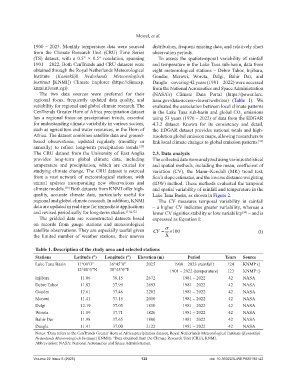
                regional  focus, frequently  updated  data  quality, and   nasa.gov/data-access-viewer/websites) (Table  1). We
                suitability for regional and global climate research. The   evaluated the association between local climate patterns
                CenTrends Greater Horn of Africa precipitation dataset   in the Lake Tana sub-basin and global CO  emissions
                                                                                                           2
                has a regional focus on precipitation trends, essential   using 53 years (1970 – 2022) of data from the EDGAR
                for understanding climate variability in various sectors,   4.3.2  dataset.  Known  for  its  consistency  and  detail,
                such as agriculture and water resources, in the Horn of   the EDGAR dataset provides national totals and high-
                Africa. The dataset combines satellite data and ground-  resolution global emission maps, allowing researchers to
                based observations, updated regularly  (monthly  or   link local climate changes to global emission patterns. [33]
                annually)  to  reflect  long-term  precipitation  trends.
                                                              [29]
                The CRU dataset from the University of East Anglia   2.3. Data analysis
                provides  long-term  global  climate  data,  including   The collected data were analyzed using various statistical
                temperature  and precipitation,  which are crucial  for   and spatial methods, including the mean, coefficient of
                studying climate change. The CRU dataset is sourced   variation  (CV),  the  Mann–Kendall  (MK)  trend  test,
                from a vast network of meteorological  stations, with   Sen’s slope estimator, and the inverse distance weighting
                annual  updates incorporating new observations  and   (IDW) method. These methods evaluated the temporal
                climate models.  Both datasets from KNMI offer high-  and spatial variability of rainfall and temperature in the
                              [30]
                quality, accurate  climate  data,  particularly  useful for   Lake Tana Basin, as shown in Figure 2.
                regional and global climate research. In addition, KNMI   The CV  measures temporal  variability  in rainfall
                data are updated in real-time for immediate applications   – a higher CV indicates greater variability, whereas a
                and revised periodically for long-term studies. [31],[32]  lower CV signifies stability or low variability  – and is
                                                                                                            [34]
                  The gridded data are reconstructed  datasets based   expressed as Equation I:
                on records from  gauge  stations  and  meteorological
                                                                          σ
                satellite observations. They are especially useful given   CV =     100×                           (I)
                the limited  number of weather stations, their  uneven    X

                 Table 1. Description of the study area and selected stations

                 Stations         Latitude (°)  Longitude (°)  Elevation (m)        Period          Years   Source
                 Lake Tana Basin   11°00’0”      36°45’0”        2025         1900 – 2023 (rainfall)  124   KNMI  ()
                                                                                                                 a
                                 – 12°40’0”N    – 38°45’0”E                 1901 – 2022 (temperature)  123  KNMI  ()
                                                                                                                 b
                 Injibara           11.06          36.15         2672            1981 – 2022          42    NASA
                 Debre Tabor        11.83          37.99         2693            1981 – 2022          42    NASA
                 Gonder             12.61          37.46         2202            1981 – 2022          42    NASA
                 Merawi             11.41          37.15         2010            1981 – 2022          42    NASA
                 Delgi              12.19          37.05         1810            1981 – 2022          42    NASA
                 Woreta             11.89          37.71         1826            1981 – 2022          42    NASA
                 Bahir Dar          11.98          37.65         1800            1981 – 2022          42    NASA
                 Dangla             11.41          37.00         2122            1981 – 2022          42    NASA
                 Notes:  Data refers to the CenTrends Greater Horn of Africa precipitation dataset, Royal Netherlands Meteorological Institute (Koninklijk
                      a
                 Nederlands Meteorologisch Instituut [KNMI]).  Data obtained from the Climate Research Unit (CRU), KNMI.
                                                   b
                 Abbreviation: NASA: National Aeronautics and Space Administration.

                Volume 22 Issue 5 (2025)                       132                           doi: 10.36922/AJWEP025190142

