


Page 14 - AJWEP-22-5
P. 14
Rajak, et al.

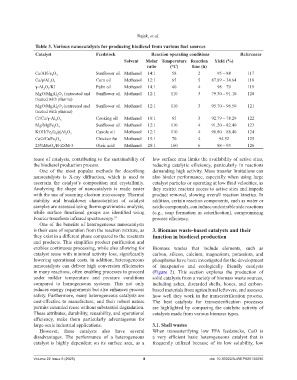
                 Table 3. Various nanocatalysts for producing biodiesel from various fuel sources
                 Catalyst                  Feedstock                Reaction operating conditions          References
                                                        Solvent  Molar  Temperature  Reaction   Yield (%)
                                                                  ratio     (°C)     time (h)
                 Cs/Al/Fe O 4              Sunflower oil Methanol  14:1      58         2        95 – 88      117
                        2
                 Ca/ℽ/Al O 3               Corn oil     Methanol  12:1       65         5     87.89 – 34.64   118
                       2
                 ℽ‐Al O /KI                Palm oil     Methanol  14:1       60         4        98 – 79      119
                      3
                    2
                 MgO/MgAl O  (untreated and   Sunflower oil Methanol  12:1  110         3     79.30 – 91.10   120
                          2
                            3
                 treated with plasma)
                 MgO/MgAl O (untreated and   Sunflower oil Methanol  12:1   110         3     95.70 – 96.50   121
                          2
                            3
                 treated with plasma)
                 Cr/Ca/ℽ‐Al O 3            Cooking oil  Methanol  18:1       65         3     92.79 – 78.29   122
                         2
                 Mg/MgFe O 4               Sunflower oil Methanol  12:1     110         4     91.20 – 82.40   123
                         2
                 KOH/Fe O @Al O 3          Canola oil   Methanol  12:1      110         4     98.80 – 88.40   124
                          4
                              2
                       3
                 CaO/CuFe O 4              Chicken fat  Methanol  15:1       70         4        94.52        125
                         2
                 25%MoO /B‐ZSM‐5           Oleic acid   Methanol  20:1      160         6        98 – 93      126
                        3
                reuse of catalysts, contributing to the sustainability of   low surface area limits the availability of active sites,
                the biodiesel production process.                   reducing  catalytic  efficiency,  particularly  in  reactions
                  One of the most popular methods for describing    demanding high activity. Mass transfer limitations can
                nanocatalysts  is  X-ray  diffraction,  which  is  used  to   also hinder performance, especially when using large
                ascertain  the catalyst’s composition  and crystallinity.   catalyst particles or operating at low fluid velocities, as
                Analyzing the shape of nanocatalysts  is made easier   they restrict reactant access to active sites and impede
                with the use of scanning electron microscopy. Thermal   product removal, slowing overall reaction kinetics. In
                stability  and breakdown characteristics  of catalyst   addition, certain reaction components, such as water or
                samples are assessed using thermogravimetric analysis,   acidic compounds, can induce undesirable side reactions
                while  surface  functional  groups  are  identified  using   (e.g.,  soap  formation  in  esterification),  compromising
                Fourier transform infrared spectroscopy. 51         process efficiency.
                  One of the benefits of heterogeneous nanocatalysts
                is their ease of separation from the reaction mixture, as   3. Biomass waste-based catalysts and their
                they exist in a different phase compared to the reactants   function in biodiesel production
                and products. This simplifies product purification and
                enables continuous processing, while also allowing for   Biomass  wastes  that  include  elements,  such  as
                catalyst reuse with minimal activity loss, significantly   carbon,  silicon,  calcium,  magnesium,  potassium,  and
                lowering operational costs. In addition, heterogeneous   phosphorus have been investigated for the development
                nanocatalysts can deliver high conversion efficiencies   of inexpensive and ecologically  friendly catalysts
                in many reactions, often enabling processes to proceed   (Figure  2).  This section  explores  the  production  of
                under milder temperature  and pressure conditions   solid catalysts from a variety of biomass waste sources,
                compared  to  homogeneous  systems.  This  not  only   including  ashes, discarded  shells, bones, and carbon-
                reduces energy requirements but also enhances process   based materials from agricultural leftovers, and assesses
                safety. Furthermore, many heterogeneous catalysts are   how well they work in the transesterification process.
                cost-effective  to  manufacture,  and  their  robust  nature   The  best  catalysts  for  transesterification  processes
                permits extended reuse without substantial degradation.   are highlighted by comparing the catalytic activity of
                These attributes, durability, reusability, and operational   catalysts made from various biomass types.
                efficiency,  make  them  particularly  advantageous  for
                large-scale industrial applications.                3.1. Shell wastes
                  However, these catalysts  also have several       When  transesterifying  low  FFA  feedstocks,  CaO  is
                disadvantages.  The performance of a heterogeneous   a  very  efficient  basic  heterogeneous  catalyst  that  is
                catalyst  is highly dependent on its surface area,  as a   frequently  utilized  because  of its low solubility, low


                Volume 22 Issue 5 (2025)                        8                            doi: 10.36922/AJWEP025130095

