


Page 15 - AJWEP-22-5
P. 15
Heterogeneous catalysts for biodiesel production


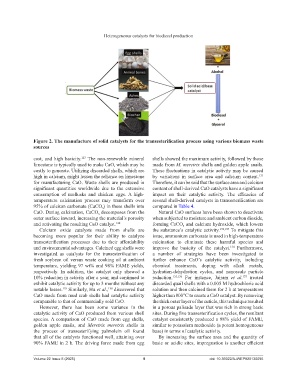
                Figure 2. The manufacture of solid catalysts for the transesterification process using various biomass waste
                sources

                cost, and high basicity.  The non-renewable mineral   shells showed the maximum activity, followed by those
                                     127
                limestone is typically used to make CaO, which may be   made from M. meretrix shells and golden apple snails.
                costly to generate. Utilizing discarded shells, which are   These fluctuations in catalytic activity may be caused
                high in calcium, might lessen the reliance on limestone   by variations in surface area and calcium  content.
                                                                                                                   131
                for manufacturing CaO. Waste shells are produced in   Therefore, it can be said that the surface area and calcium
                significant  quantities  worldwide  due  to  the  extensive   content of shell-derived CaO catalysts have a significant
                consumption of mollusks and chicken eggs.  A  high-  impact  on  their  catalytic  activity.  The  efficacies  of
                temperature  calcination  process may  transform  over   several shell-derived catalysts in transesterification are
                95% of calcium carbonate (CaCO ) in these shells into   compared in Table 4.
                                              3
                CaO. During calcination, CaCO  decomposes from the     Natural CaO surfaces have been shown to deactivate
                                            3
                outer surface inward, increasing the material’s porosity   when subjected to moisture and ambient carbon dioxide,
                and activating the resulting CaO catalyst. 128      forming CaCO  and calcium hydroxide, which lowers
                                                                                  3
                  Calcium oxide catalysts made from shells are      the substance’s catalytic activity. 132,133  To mitigate this
                becoming more popular for their ability to catalyze   issue, ammonium carbonate is used in high-temperature
                transesterification  processes  due  to  their  affordability   calcination  to eliminate  these harmful species and
                and environmental advantages. Calcined egg shells were   improve the basicity  of the catalyst.  Furthermore,
                                                                                                      134
                investigated  as  catalysts  for  the  transesterification  of   a number of strategies have been investigated  to
                fresh soybean oil versus waste cooking oil at ambient   further enhance CaO’s catalytic  activity, including
                temperature, yielding 97 wt% and 98% FAME yields,   chemical  treatments,  doping with alkali  metals,
                respectively. In addition, the catalyst only showed a   hydration-dehydration  cycles, and nanoscale  particle
                10% reduction in activity after a year, and continued to   reduction. 135,136  For instance,  Jairam  et al.  treated
                                                                                                            137
                exhibit catalytic activity for up to 3 months without any   discarded quail shells with a 0.005 M hydrochloric acid
                notable losses.  Similarly, Hu et al.,  discovered that   solution and then calcined them for 2 h at temperatures
                             129
                                                 130
                CaO made from mud crab shells had catalytic activity   higher than 800°C to create a CaO catalyst. By removing
                comparable to that of commercially sold CaO.        the thick outer layer of the cuticle, this technique resulted
                  However, there has been some variance  in the     in a porous palisade layer that was rich in strong basic
                catalytic activity of CaO produced from various shell   sites. During five transesterification cycles, the resultant
                species. A comparison of CaO made from egg shells,   catalyst consistently produced a 98% yield of FAME,
                golden apple snails, and  Meretrix meretrix  shells in   similar to potassium methoxide (a potent homogeneous
                the  process of transesterifying  palmolein  oil found   base) in terms of catalytic activity.
                that all of the catalysts functioned well, attaining over   By increasing the surface area and the quantity of
                90% FAME in 2 h. The driving force made from egg    basic or acidic sites, impregnation is another efficient


                Volume 22 Issue 5 (2025)                        9                            doi: 10.36922/AJWEP025130095

