


Page 16 - AJWEP-22-5
P. 16
Rajak, et al.

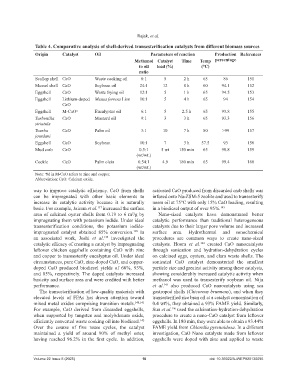
                 Table 4. Comparative analysis of shell‑derived transesterification catalysts from different biomass sources
                 Origin      Catalyst      Oil                     Parameters of reaction       Production  References
                                                            Methanol  Catalyst   Time    Temp   percentage
                                                              to oil   load (%)           (°C)
                                                              ratio
                 Scallop shell CaO         Waste cooking oil   6:1       5        2 h     65       86         151
                 Mussel shell CaO          Soybean oil         24:1      12       8 h     60       94.1       152
                 Eggshell    CaO           Waste frying oil    12:1      5        1 h     65       94.5       153
                 Eggshell    Lithium-doped  Mesua ferrera Linn  10:1     5        4 h     65       94         154
                             CaO
                 Eggshell    M-CaO a       Eucalyptus oil      6:1       5       2.5 h    65       93.8       155
                 Turbonilla   CaO          Mustard oil         9:1       3        3 h     65       93.3       156
                 striatula
                 Tourbo      CaO           Palm oil            3:1       10       7 h     80       >99        157
                 jourdani
                 Eggshell    CaO           Soybean             10:1      7        3 h     57.5     93         158
                 Mud crab    CaO                              0.5:1     5 wt    150 min   65       98.8       159
                                                             (wt/wt.)
                 Cockle      CaO           Palm olein         0.54:1     4.9    180 min   65       99.4       160
                                                             (wt/wt.)
                     a
                 Note:  M in M-CaO refers to zinc and copper.
                 Abbreviation: CaO: Calcium oxide.
                way  to  improve  catalytic  efficiency.  CaO  from  shells   activated CaO produced from discarded crab shells was
                can be impregnated with other basic elements  to    infused onto Na-ZSM-5 zeolite and used to transesterify
                increase  its  catalytic  activity  because  it  is naturally   neem oil at 75°C with only 15% CaO loading, resulting
                basic. For example, Jairam et al.  increased the surface   in a biodiesel output of over 95%. 143
                                            137
                area of calcined oyster shells from 0.19 to 6 m /g by   Nano-sized catalysts  have demonstrated  better
                                                           2
                impregnating them with potassium iodide. Under ideal   catalytic  performance  than traditional  heterogeneous
                transesterification  conditions,  the  potassium  iodide-  catalysts due to their larger pore volume and increased
                impregnated  catalyst obtained 85% conversion.  In   surface  area.  Hydrothermal  and  sonochemical
                                                            138
                an  associated  work, Joshi  et  al.  investigated  the   procedures  are  common  ways to  create  nano-sized
                                               139
                catalytic efficacy of creating a catalyst by impregnating   catalysts. Hoora  et al.  created CaO nanocatalysts
                                                                                         144
                leftover  chicken  eggshells  containing  CaO  with  zinc   through sonication and hydration-dehydration  cycles
                and copper to transesterify eucalyptus oil. Under ideal   on calcined eggs, oysters, and clam waste shells. The
                circumstances, pure CaO, zinc-doped CaO, and copper-  sonicated CaO catalyst  demonstrated  the smallest
                doped  CaO produced  biodiesel  yields  of 68%, 93%,   particle size and greatest activity among these catalysts,
                and 85%, respectively. The  doped catalysts  increased   showing considerably increased catalytic activity when
                basicity and surface area and were credited with better   methanol  was used to transesterify soybean oil.  Niju
                performance.                                        et al.  also produced CaO nanocatalysts using sea
                                                                         145
                  The transesterification of low-quality materials with   gastropod shells (Chicoreus brunneus), and when they
                elevated  levels of FFAs has drawn attention  toward   transesterified rice bran oil at a catalyst concentration of
                mixed metal oxides comprising transition metals. 140,141    0.4 wt%, they obtained a 93% FAME yield. Similarly,
                For example,  CaO derived  from  discarded  eggshells,   Sun et al.  used the calcination-hydration-dehydration
                                                                             146
                when supported by tungsten and molybdenum oxide,    procedure to create a nano-CaO catalyst from leftover
                efficiently converted waste cooking oil into biodiesel.    eggshells. In 180 min, they were able to obtain a 93.44%
                                                               142
                Over  the  course  of  five  reuse  cycles,  the  catalyst   FAME yield from Chlorella pyrenoidosa. In a different
                maintained  a yield  of around 90% of methyl  ester,   investigation, CaO Nano catalysts made from leftover
                having  reached  96.2%  in  the  first  cycle.  In  addition,   eggshells were doped with zinc and applied to waste


                Volume 22 Issue 5 (2025)                        10                           doi: 10.36922/AJWEP025130095

