


Page 20 - AJWEP-22-5
P. 20
Rajak, et al.

                and  temperatures.  Pork bone-derived  hydroxyapatite   in ash, such as lime and potash, it is frequently used as a
                catalysts have been utilized for the transesterification of   fertilizer. Wood ash also possesses the capacity to act as
                J. curcas oil, achieving a biodiesel yield of 94% with   a heterogeneous base catalyst due to its high alkalinity
                an 18:1 methanol-to-oil  molar ratio  and 4% catalyst   and inorganic composition. In an initial investigation,
                load for 5 min in optimal temperature conditions. Cow   Eldiehy et al.  used a catalytic process to examine the
                                                                                188
                bone-derived CaO catalysts have been employed for   transesterification of Jatropha oil from alkaline wood
                the transesterification of waste frying oil, yielding 96%   ash. A solid-state reaction involving double-carbonated
                biodiesel under a 12:1 methanol-to-oil molar ratio and   potassium carbonate and CaCO catalyzed the activation
                                                                                                3
                20% catalyst load for 8 h at 70°C. Aceh cow bone-derived   of calcined  wood ash, which was manufactured  at
                CaO catalysts have been used for the transesterification   temperatures between  500 and 1,200°C. This process
                of castor oil, yielding 58.7% biodiesel under a 12:1   resulted in the formation of activated wood ash catalysts
                methanol-to-oil molar ratio and 6% catalyst load for 4 h   that  converted  Jatropha oil to FAME at a rate  of
                                                                                                     189
                at 65°C. The potential of utilizing various animal bone-  97 – 99%. In their study, Kumar et al.  used an alkaline
                derived catalysts in biodiesel production highlights the   heterogeneous catalyst made from sugarcane leaf ash to
                importance of optimizing reaction parameters to achieve   transesterify C. inophyllum oil. The catalyst was made
                high yields. The choice of animal bone source, calcination   from the leftover  ash after  the silica  was removed.
                temperature,  and  reaction  conditions  significantly   Fourier transform infrared examination  showed  that
                influence the catalytic efficiency and biodiesel yield.  MgO,  CaO, and CaCO were present.  Although a
                                                                                           3
                                                                    22% decrease  in yield  was seen after  10  cycles,  the
                3.3. Ash biomass                                    catalyst attained a 97% FAME production under ideal
                A substantial quantity of agricultural waste produced   circumstances, which included a 19:1 methanol-to-oil
                annually across the world is burnt for fuel, producing a   ratio and 5 wt% catalyst concentration at 64°C. 190
                large amount of ash. The primary constituents of biomass,   Similar to this, walnut shell ash was investigated as a
                in order of abundance, are carbon, oxygen, hydrogen,   catalyst for sunflower oil transesterification, producing
                nitrogen, calcium, potassium, silicon, magnesium,   a 98% FAME production in 10 min. The high catalytic
                aluminum, sulfur, iron, phosphorus, chlorine, sodium,   activity is attributed to the presence of potent basic sites,
                manganese, and titanium.   Burning  biomass  at  high   including CaO and K O.  As a heterogeneous catalyst,
                                                                                          191
                                       186
                                                                                       2
                temperatures lowers its carbon and oxygen content, and   the  transesterification  of  sunflower  oil  and  Sesamum
                calcining the resultant ash enhances its basicity as it   indicum  waste  from plant  ash was also  examined.
                contains CaO, MgO, and potassium oxide (K O), which are   Rich in carbonates, K O (29.64 wt%), and CaO (33.80
                                                     2
                                                                                        2
                examples of alkali metal oxides. Ash derived from calcined   wt%), as well as sodium, magnesium, iron, manganese,
                biomass can therefore function as a basic catalyst. 187  zinc,  silicon,  strontium,  and chlorine,  this catalyst
                  In India, wood has been widely used for millennia   demonstrated exceptional catalytic activity, obtaining a
                to produce heat, particularly in rural regions, which has   98.9% FAME yield in 40 min under ideal conditions,
                resulted in a significant amount of wood ash, as shown   which included a 12:1 molar ratio of alcohol to oil and
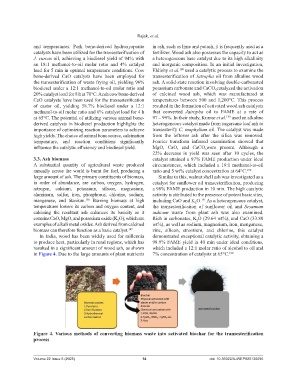
                in Figure 4. Due to the large amounts of plant nutrients   7% concentration of catalysts at 65°C. 192


                Figure  4. Various  methods  of  converting  biomass  waste  into  activated  biochar  for  the  transesterification
                process


                Volume 22 Issue 5 (2025)                        14                           doi: 10.36922/AJWEP025130095

