


Page 22 - AJWEP-22-5
P. 22
Rajak, et al.

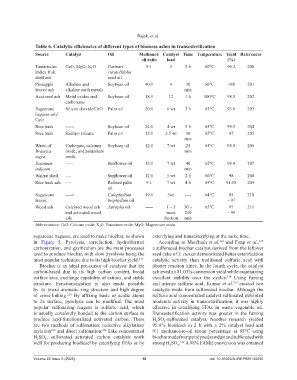
                 Table 6. Catalytic efficiencies of different types of biomass ashes in transesterification
                 Source       Catalyst          Oil           Methanol/ Catalyst  Time Temperature Yield  References
                                                               oil ratio  load                       (%)
                 Tamarindus   CaO, MgO, K O     Parinari         9:1        5      2 h     60°C      96.2     200
                                         2
                 indica fruit                   curatellifolia
                 shell ash                      seed oil
                 Pineapple    Alkaline and      Soybean oil      40:1       4      30      60°C      >98      201
                 leaves ash   alkaline earth metals                               min
                 Acai seed ash  Metal oxides and   Soybean oil   18:1      12      1 h     100°C     98.5     202
                              carbonates
                 Sugarcane    Silicon dioxide/CaO  Palm oil      20:1      6 wt    3 h     65°C      93.8     203
                 bagasse ash/
                 CaO
                 Rice husk    ------            Soybean oil      24:1      4 wt    3 h     65°C      99.5     204
                 Rice husk    Sodium silicate   Palm oil         12:1     2.5 wt   30      65°C       97      205
                                                                                  min
                 Waste of     Carbonate, calcium   Soybean oil   12:1      7 wt    25      65°C      98.8     206
                 Brassica     oxide, and potassium                                min
                 nigra        oxide
                 Sesamum      -----             Sunflower oil    12:1      7 wt    40      65°C      98.9     207
                 indicum                                                          min
                 Walnut shell  ----             Sunflower oil    12:1      5 wt    2 h     60°C       98      208
                 Rice husk ash  ----            Refined palm     9:1       7 wt    4 h     65°C      91.58    209
                                                oil
                 Sugarcane    ----=             Calophyllum      19:1      5wt    ----     64°C       85      210
                 leaves                         inophyllum oil                                       – 97
                 Wood ash     Calcined wood ash   Jatropha oil   -----    1 – 3   30 –     65°C       97      211
                              and activated wood                          mass    210                – 99
                              ash                                        fraction  min
                 Abbreviations: CaO: Calcium oxide; K 2 O: Potassium oxide; MgO: Magnesium oxide.

                sugarcane bagasse, are used to make biochar, as shown   esterifying and transesterifying at the same time.
                in  Figure  5. Pyrolysis, torrefaction,  hydrothermal   According to Mardhiah et al.  and Feng et al.,
                                                                                                  216
                                                                                                                   217
                carbonization, and gasification are the main processes   a sulfonated biochar catalyst derived from the leftover
                used to produce biochar, with slow pyrolysis being the   seed cake of J. curcas demonstrated better esterification
                most popular technique due to its high biochar yield. 213  catalytic  activity than traditional  sulfuric acid  with
                  Biochar is an ideal pre-cursor of catalysts that are   shorter reaction times. In the fourth cycle, the catalyst
                carbon-based due to its high carbon content, broad   achieved an 81.03% conversion yield while maintaining
                surface area, exchange capability of cations, and stable   excellent  stability over the cycles.  Using  fuming
                                                                                                     218
                structure.  Functionalization  is also  made  possible   and intense sulfuric acid, Kumar et al.  created two
                                                                                                        219
                by its broad aromatic  ring structure  and high degree   catalysts made from sulfonated biochar. Although the
                of cross-linking.   By  affixing  basic  or  acidic  atoms   sulfuric acid-concentrated catalyst sulfonated exhibited
                               214
                to  its  surface,  pyrolysis  can  be  modified.  The  most   moderate  activity  in  transesterification,  it  was  highly
                popular sulfonating  reagent is sulfuric  acid,  which   effective  in  esterifying  FFAs  in  waste  vegetable  oil.
                is usually covalently bonded to the carbon surface to   Transesterification  activity  was  greater  in  the  fuming
                produce  acid-functionalized  activated  carbon.  There   H SO -sulfonated catalyst.  Another research yielded
                                                                      2
                                                                         4
                are two methods of sulfonation:  reductive  alkylation/  95.6%  biodiesel  in  2  h  with  a  2%  catalyst  load  and
                arylation  and direct sulfonation.  Like concentrated   9:1  methanol-to-oil  molar  percentage  at 85°C using
                        215
                                              216
                H SO , sulfonated  activated  carbon  catalysts  work   biochar made from pyrolyzed sawdust and sulfonated with
                 2
                     4
                well for producing biodiesel by esterifying FFAs or by   strong H SO .  A 98% FAME conversion was obtained
                                                                                122
                                                                            2
                                                                               4
                Volume 22 Issue 5 (2025)                        16                           doi: 10.36922/AJWEP025130095

