


Page 18 - AJWEP-22-5
P. 18
Rajak, et al.

                 Table 5. Efficiencies of bone catalysts produced from different types of transesterification processes
                 Origin     Catalyst Oil                    Parameters of reaction           Production    References
                                                    Methanol  Catalyst  Time a  Temperature   percentage
                                                   to oil ratio load (%)          (°C)
                 Waste      -----    Waste cooking    15:1       5       4        60            90.56         176
                 ostrich bone        oil
                 Quail waste  -----  Canola oil,      1:12       7       4        65       89.4 from canola   177
                 head                rapeseed oil,                                           oil, 91 from
                                     waste cooking                                           rapeseed oil,
                                     oil                                                   91.7 from waste
                                                                                             cooking oil
                 Waste      CaO      Palm oil         1:18       20      4        65            96.78         178
                 animal bone
                 Fishbone   CaO      Waste cooking    15:1       5       4        ---           89.33         179
                                     oil
                 Pork bone  NHAp     Jatropha curcas  18:1       4     5 min      -----          94           180
                 Fishbone   CaO      Palm oil         12:1      4.02    6.11      65            94.30         181
                 Cow bone   CaO      Waste frying oil  12:1      20      8        70             96           182
                 Aceh cow   CaO      Castor oil       12:1       6       4        65            58.7          183
                 bone
                 Fishbone   CaO      Palm oil         12:1       10      4        65            77.2          184
                 Fishbone   CaO      Palm oil         18:1       10      2        65             90           185
                 Note:  Time is depicted as hours unless stated otherwise.
                     a
                 Abbreviations: CaO: Calcium oxide; NHAp: Pork bone-derived hydroxyapatite.


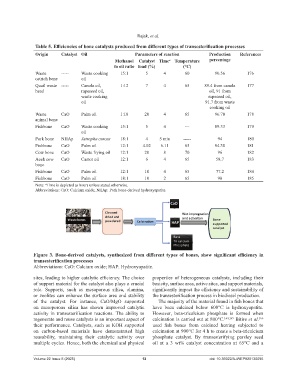
                Figure 3. Bone‑derived catalysts, synthesized from different types of bones, show significant efficiency in
                transesterification processes
                Abbreviations: CaO: Calcium oxide; HAP: Hydroxyapatite.

                sites, leading to higher catalytic efficiency. The choice   properties of heterogeneous  catalysts,  including  their
                of support material for the catalyst also plays a crucial   basicity, surface area, active sites, and support materials,
                role. Supports, such as mesoporous silica, alumina,   significantly impact the efficiency and sustainability of
                or zeolites can enhance the surface area and stability   the transesterification process in biodiesel production.
                of the  catalyst. For instance, CaO/MgO supported      The majority of the material found in fish bones that
                on mesoporous silica  has shown improved  catalytic   have been calcined below 600°C is hydroxyapatite.
                activity  in  transesterification  reactions.  The  ability  to   However, beta-tricalcium  phosphate  is formed  when
                regenerate and reuse catalysts is an important aspect of   calcination is carried out at 800°C. 164,165  Bitire et al.
                                                                                                                   166
                their performance. Catalysts, such as KOH supported   used  fish  bones  from  calcined  herring  subjected  to
                on  carbon-based  materials  have  demonstrated  high   calcination at 900°C for 4 h to create a beta-tricalcium
                reusability, maintaining  their  catalytic  activity  over   phosphate  catalyst.  By  transesterifying  parsley  seed
                multiple cycles. Hence, both the chemical and physical   oil at a 3 wt% catalyst concentration  at 65°C and a


                Volume 22 Issue 5 (2025)                        12                           doi: 10.36922/AJWEP025130095

