


Page 25 - AJWEP-22-5
P. 25
Heterogeneous catalysts for biodiesel production

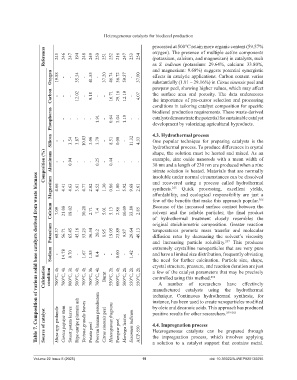
                                                                    processed at 500°C retain more organic content (59.57%
                     References  245  246  247  194  248  249  250  251  252  216  247  253  254  oxygen). The presence of multiple active components
                                                                    (potassium, calcium, and magnesium) in catalysts, such
                                                                    as  S. indicum (potassium: 29.64%, calcium: 33.80%,
                                                                    and magnesium: 9.68%) suggests potential synergistic
                        Oxygen  19.88  -  -  35.34  -  41.55  -  37.20  46.74  36.72  59.57  -  37.00  effects in catalytic applications. Carbon content varies

                                                                    substantially (1.91 – 29.16%) in Citrus sinensis peel and
                                                                    pawpaw peel, showing higher values, which may affect
                        Carbon  -  -  -  12.02  -  9.18  -  -  16.71  29.16  12.19  -  4.07  the surface area and porosity.  The data underscores
                                                                    the importance of pre-cursor selection and processing
                                                                    conditions in tailoring catalyst composition for specific
                        Phosphorus  -  -  -  -  -  1.91  -  0.64  3.04  1.19  -  -  catalysts demonstrate the potential for sustainable catalyst
                                                                    biodiesel production requirements. These waste-derived
                                                                    development by valorizing agricultural byproducts.


                        Silicon  -  -  3.54  3.87  10.03  3.06  3.79  -  8.51  0.00  -  11.32  4.33  4.3. Hydrothermal process
                                                                    One popular technique  for preparing  catalysts  is the
                                                                    hydrothermal process. To produce differences in crystal
                     Composition (%)  Aluminum  -  -  0.94  -  -  -  0.25  -  0.44  -  -  -  -  example,  zinc oxide nanorods with a mean width of
                                                                    shape, the solution must be heated and mixed. As an
                                                                    38 nm and a length of 230 nm are produced when a zinc
                                                                    nitrate solution is heated. Materials that are normally
                 Table 7. Composition of various solid base catalysts derived from waste biomass
                                                                    insoluble under normal circumstances can be dissolved
                        Magnesium  4.66  4.41  4.63  3.61  4.77  2.02  4.52  1.30  0.86  1.00  5.92  9.68  2.61  and recovered using a process called  hydrothermal
                                                                    synthesis.  Quick processing, excellent  yields,
                                                                             255
                                                                    affordability,  and  ecological  responsibility  are  just  a
                                                                    few of the benefits that make this approach popular.
                                                                                                                   256
                        Calcium  7.09  21.08  18.02  -  30.28  2.71  7.4  5.01  5.13  2.86  10.09  33.80  2.85  Because of the increased surface contact between the
                                                                    solvent  and  the  soluble  particles;  the  final  product
                                                                    of hydrothermal treatment closely resembles the
                        Potassium  68.37  56.71  65.45  45.16  53.25  36.54  20.2  8.95  19.05  23.89  9.87  29.64  49.13  original  stoichiometric  composition.  Greater  reaction
                                                                    temperatures  promote  mass transfer  and  molecular
                                                                    diffusion  rates  by  decreasing  the  solvent’s  viscosity
                                                                    and increasing particle  solubility.  This  produces
                                                                                                    257
                        Sodium  -  14.78  0.70  -  1.67  1.85  0.4  -  -  0.00  -  1.42  -  extremely crystalline nanoparticles that  are  very  pure
                                                                    and have a limited size distribution, frequently obviating
                                                                    the need for further calcination. Particle size, shape,
                     Calcination   condition  700°C, 4h  700°C, 4h  900°C, 3h  500°C, 4h  700°C, 4h  700°C, 3h  700°C, 4h  Burnt  550°C, 2h  600°C, 4h  500°C, 2h  550°C, 2h  550°C, 2h  crystal structure, pressure, and reaction duration are just
                                                                    a few of the catalyst parameters that may be precisely
                                                                    controlled using this method.
                                                                                              258
                                                                       A  number  of  researchers  have  effectively
                                                                    manufactured  catalysts  using the  hydrothermal
                                                                    technique.  Continuous hydrothermal  synthesis, for
                                                                    instance, has been used to create nanoparticles modified
                                                                    by oleic and decanoic acids. This approach has produced
                     Source of catalyst  Musa spp. peduncle  Carica papaya stem  Sweet potato leaves  Ripe-unripe plantain ash  Tectona grandis leaves  Potato peel  Poovan banana pseudostem  Citrus sinensis peel  Heteropanax fragrans  Pawpaw peel  Moringa leaves  Sesamum indicum  ACP-550  positive results for other researchers. 259-262


                                                                    4.4. Impregnation process
                                                                    Heterogeneous catalysts  can be prepared through
                                                                    the impregnation process, which involves applying


                Volume 22 Issue 5 (2025)                        19   a  solution  to  a catalyst  support that  contains  metal.
                                                                                             doi: 10.36922/AJWEP025130095

