


Page 188 - AJWEP-22-5
P. 188
Hou, et al.

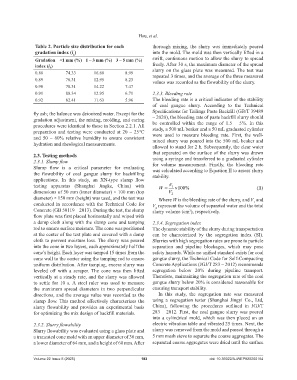
                 Table 2. Particle size distribution for each       thorough  mixing,  the  slurry  was  immediately  poured
                 gradation index (i )                               into the mold. The mold was then vertically lifted in a
                                 k
                 Gradation  <1 mm (%) 1 – 3 mm (%) 3 – 5 mm (%)     swift, continuous motion to allow the slurry to spread
                 index (i k )                                       freely. After 30 s, the maximum diameter of the spread
                 0.88         74.33       16.68         8.99        slurry on the glass plate was measured. The test was
                                                                    repeated 3 times, and the average of the three measured
                 0.89         76.31       12.95         8.23        values was recorded as the flowability of the slurry.
                 0.90         78.31       14.22         7.47
                 0.91         80.34       12.95         6.71        2.3.3. Bleeding rate
                 0.92         82.41       11.63         5.96        The bleeding rate is a critical indicator of the stability
                                                                    of  coal  gangue  slurry.  According  to  the  Technical
                fly ash; the balance was deionized water. Except for the   Specifications for Tailings Paste Backfill (GB/T 39489
                gradation adjustment, the mixing, molding, and curing   – 2020), the bleeding rate of paste backfill slurry should
                procedures were identical to those in Section 2.2.1. All   be  controlled  within  the  range  of  1.5  –  5%.  In  this
                preparation and testing were conducted at 20 – 25°C   study, a 500 mL beaker and a 50 mL graduated cylinder
                                                                    were  used  to  measure  bleeding  rate.  First,  the  well-
                and  50  –  60%  relative  humidity  to  ensure  consistent   mixed slurry was poured into the 500 mL beaker and
                hydration and rheological measurements.             allowed to stand for 2 h. Subsequently, the clear water


                2.3. Testing methods                                that separated on the surface of the slurry was drawn
                                                                    using a syringe and transferred to a graduated cylinder
                2.3.1. Slump flow                                   for  volume  measurement.  Finally,  the  bleeding  rate
                Slump  flow  is  a  critical  parameter  for  evaluating   was calculated according to Equation II to assess slurry
                the  flowability  of  coal  gangue  slurry  for  backfilling   stability.
                applications.  In  this  study,  an  XN-type  slump  flow
                testing  apparatus  (Shanghai  Jingke,  China)  with   W   V 1  100%                            (II)
                dimensions of 50 mm (inner diameter) × 100 mm (top         V 2
                diameter) × 150 mm (height) was used, and the test was   Where W is the bleeding rate of the slurry, and V  and
                                                                                                                 1
                conducted in accordance with the Technical Code for   V  represent the volume of separated water and the total
                                                                      2
                Concrete (GB 50119 – 2013). During the test, the slump   slurry volume (cm ), respectively.
                                                                                    3
                flow plate was first placed horizontally and wiped with
                a damp cloth along with the slump cone and tamping   2.3.4. Segregation index
                rod to ensure surface moisture. The cone was positioned   The dynamic stability of the slurry during transportation
                at the center of the test plate and covered with a damp   can  be  characterized  by  the  segregation  index  (SI).
                cloth to prevent moisture loss. The slurry was poured   Slurries with high segregation rates are prone to particle
                into the cone in two layers, each approximately half the   separation  and  pipeline  blockages,  which  may  pose
                cone’s height. Each layer was tamped 15 times from the   safety hazards. While no unified standard exists for coal
                cone wall to the center using the tamping rod to ensure   gangue slurry, the Technical Code for Self-Compacting
                uniform distribution. After tamping, excess slurry was   Concrete Applications (JGJ/T 283 – 2012) recommends
                leveled  off  with  a  scraper.  The  cone  was  then  lifted   segregation  below  20%  during  pipeline  transport.
                vertically at a steady rate, and the slurry was allowed   Therefore, maintaining the segregation rate of the coal
                to  settle  for  10  s. A  steel  ruler  was  used  to  measure   gangue slurry below 20% is considered reasonable for
                the  maximum  spread  diameters  in  two  perpendicular   ensuring transport stability.
                directions, and the average value was recorded as the   In  this  study,  the  segregation  rate  was  measured
                slump flow. This method effectively characterizes the   using  a  segregation  tester  (Shanghai  Jingyi  Co.,  Ltd,
                slurry  flowability  and  provides  an  experimental  basis   China),  following  the  procedures  outlined  in  JGJ/T
                for optimizing the mix design of backfill materials.  283 – 2012. First, the coal gangue slurry was poured
                                                                    into a cylindrical mold, which was then placed on an
                2.3.2. Slurry flowability                           electric vibration table and vibrated 25 times. Next, the
                Slurry flowability was evaluated using a glass plate and   slurry was removed from the mold and passed through a
                a truncated cone mold with an upper diameter of 36 mm,   5 mm mesh sieve to separate the coarse aggregates. The
                a lower diameter of 64 mm, and a height of 60 mm. After   separated coarse aggregates were dried until the surface


                Volume 22 Issue 5 (2025)                       182                           doi: 10.36922/AJWEP025200154

