


Page 191 - AJWEP-22-5
P. 191
Use of coal gangue for mine backfill

                sharply, suggesting a transition to a more cohesive and
                less flowable system. Although this improves stability
                and reduces segregation, it may cause increased pressure
                losses and clogging risks during pumping.
                  Overall,  the  Bingham  model  provides  a  robust
                framework for characterizing the rheological behavior
                of the coal gangue-fly ash slurry. Both plastic viscosity
                and  yield  stress  increase  with  solid  concentration,
                reflecting  a  shift  toward  reduced  flowability  but
                enhanced  structural  integrity.  These  findings  offer
                critical insights into optimizing slurry formulations for
                practical applications. Careful control of concentration,
                therefore, allows engineers to balance flowability and
                stability, ensuring efficient pipeline transport, improved
                workability, and reliable performance in backfilling and
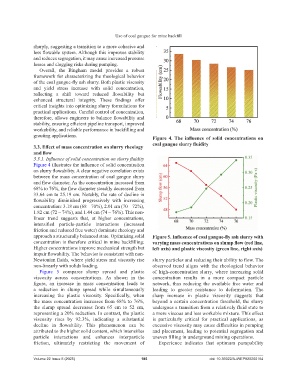
                grouting applications.                              Figure  4.  The  influence  of  solid  concentrations  on

                3.3. Effect of mass concentration on slurry rheology   coal gangue slurry fluidity
                and flow
                3.3.1. Influence of solid concentration on slurry fluidity
                Figure 4 illustrates the influence of solid concentration
                on slurry flowability. A clear negative correlation exists
                between the mass concentration of coal gangue slurry
                and flow diameter. As the concentration increased from
                68% to 76%, the flow diameter steadily decreased from
                33.64 cm to 25.19 cm. Notably, the rate of decline in
                flowability  diminished  progressively  with  increasing
                concentration: 3.18 cm (68 – 70%), 2.01 cm (70 – 72%),
                1.82 cm (72 – 74%), and 1.44 cm (74 – 76%). This non-
                linear  trend  suggests  that,  at  higher  concentrations,
                intensified  particle-particle  interactions  (increased
                friction and reduced free water) dominate rheology and
                approach a structurally balanced state. Optimizing solid   Figure 5. Influence of coal gangue‑fly ash slurry with
                concentration is therefore critical in mine backfilling:   varying mass concentrations on slump flow (red line,
                Higher concentrations improve mechanical strength but   left axis) and plastic viscosity (green line, right axis)
                impair flowability. The behavior is consistent with non-
                Newtonian fluids, where yield stress and viscosity rise   slurry particles and reducing their ability to flow. The
                non-linearly with solids loading.                   observed  trend  aligns  with  the  rheological  behavior
                  Figure  5  compares  slump  spread  and  plastic   of  high-concentration  slurry,  where  increasing  solid
                viscosity  across  concentrations.  As  shown  in  the   concentration  results  in  a  more  compact  particle
                figure,  an  increase  in  mass  concentration  leads  to   network, thus reducing the available free water and
                a  reduction  in  slump  spread  while  simultaneously   leading  to  greater  resistance  to  deformation.  The
                increasing  the  plastic  viscosity.  Specifically,  when   sharp  increase  in  plastic  viscosity  suggests  that
                the mass concentration increases from 68% to 76%,   beyond  a  certain  concentration  threshold,  the  slurry
                the  slump  spread  decreases  from  65  cm  to  52  cm,   undergoes a transition from a relatively fluid state to
                representing a 20% reduction. In contrast, the plastic   a more viscous and less workable mixture. This effect
                viscosity  rises  by  92.3%,  indicating  a  substantial   is  particularly  critical  for  practical  applications,  as
                decline  in  flowability.  This  phenomenon  can  be   excessive viscosity may cause difficulties in pumping
                attributed to the higher solid content, which intensifies   and  placement,  leading  to  potential  segregation  and
                particle  interactions  and  enhances  interparticle   uneven filling in underground mining operations.
                friction,  ultimately  restricting  the  movement  of   Experience  indicates  that  optimum  pumpability


                Volume 22 Issue 5 (2025)                       185                           doi: 10.36922/AJWEP025200154

