


Page 194 - AJWEP-22-5
P. 194
Hou, et al.

                optimal balance between mechanical performance and   3.4. Influence of particle size pairing on the
                flowability.  Its  28-day  compressive  strength  reaches   rheological properties of the slurry
                5.25  MPa,  meeting  the  basic  strength  requirements   3.4.1. Influence of particle size matching on the fluidity
                for  typical  backfill  applications  (≥5  MPa),  while  its   and stability of the slurry
                7- and 14-day strengths are 2.52 MPa and 3.69 MPa,   To  investigate  the  effect  of  particle  grading  on  the
                respectively  –  indicative  of  stable  early-age  strength   performance  of  coal  gangue  slurry,  a  comparative
                development.  Compared  with  higher  concentrations   analysis  was  conducted  on  the  slurry’s  flowability,
                (74%  and  76%),  the  72%  concentration  not  only   water  separation,  and  structural  stability  under
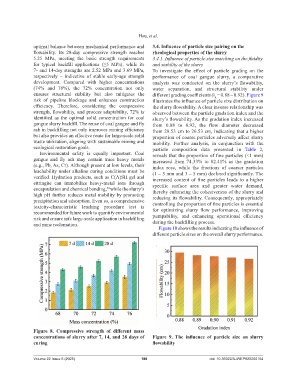
                ensures  structural  stability  but  also  mitigates  the   different grading coefficients (i  = 0.88 – 0.92). Figure 9
                                                                                                k
                risk  of  pipeline  blockage  and  enhances  construction   illustrates the influence of particle size distribution on
                efficiency.  Therefore,  considering  the  compressive   the slurry flowability. A clear inverse relationship was
                strength, flowability, and process adaptability, 72% is   observed between the particle gradation index and the
                identified  as  the  optimal  solid  concentration  for  coal   slurry’s flowability. As the gradation index increased
                gangue slurry backfill. The reuse of coal gangue and fly   from  0.88  to  0.92,  the  flow  diameter  decreased
                ash in backfilling not only improves mining efficiency   from 29.53 cm to 26.53 cm, indicating that a higher
                but also provides an effective route for large-scale solid   proportion of coarse particles adversely affect slurry
                waste utilization, aligning with sustainable mining and   mobility.  Further  analysis,  in  conjunction  with  the
                ecological restoration goals.                       particle  composition  data  presented  in  Table  2,
                  Environmental  safety  is  equally  important.  Coal   reveals that the proportion of fine particles (<1 mm)
                gangue  and  fly  ash  may  contain  trace  heavy  metals   increased  from  74.33%  to  82.41%  as  the  gradation
                (e.g., Pb, As, Cr). Although present at low levels, their   index  rose,  while  the  fractions  of  coarser  particles
                leachability  under  alkaline  curing  conditions  must  be   (1 – 3 mm and 3 – 5 mm) declined significantly. The
                verified. Hydration products, such as C(A)SH gel and   increased  content  of  fine  particles  leads  to  a  higher
                ettringite  can  immobilize  heavy-metal  ions  through   specific  surface  area  and  greater  water  demand,
                encapsulation and chemical bonding, while the slurry’s   thereby enhancing the cohesiveness of the slurry and
                                                34
                high pH further reduces metal mobility by promoting   reducing its flowability. Consequently, appropriately
                precipitation and adsorption. Even so, a comprehensive
                toxicity-characteristic  leaching  procedure  test  is   controlling the proportion of fine particles is essential
                recommended for future work to quantify environmental   for  optimizing  slurry  flow  performance,  improving
                risk and ensure safe large-scale application in backfilling   pumpability,  and  enhancing  operational  efficiency
                and mine reclamation.                               during the backfilling process.
                                                                       Figure 10 shows the results indicating the influence of
                                                                    different particle sizes on the overall slurry performance.


                Figure  8.  Compressive  strength  of  different  mass
                concentrations of slurry after 7, 14, and 28 days of   Figure  9.  The  influence  of  particle  size  on  slurry
                curing                                              flowability


                Volume 22 Issue 5 (2025)                       188                           doi: 10.36922/AJWEP025200154

