


Page 195 - AJWEP-22-5
P. 195
Use of coal gangue for mine backfill

                As i  increased, the slump decreased from 59.8 cm to   The  resulting  improvement  in  homogeneity  and
                    k
                55.0  cm,  indicating  a  trend  of  decreasing  flowability   pumpability  ensures  good  construction  workability.
                as the particle distribution became more compact. This   Therefore, i  = 0.91 is considered the optimal particle
                                                                               k
                trend is attributed to the enhanced packing density and an   grading  parameter  for  coal  gangue  slurry,  striking  a
                increased proportion of coarse particles, both of which   balance  between  flowability  and  structural  stability.
                led to higher internal shear resistance. Meanwhile, the   This  grading  optimization  not  only  improves  slurry
                water  separation  and  segregation  rates  significantly   performance  in  engineering  applications  but  also
                decreased from 4.8% and 23.0% to 2.9% and 16.5%,    promotes the high-value utilization of coal gangue and
                respectively,  suggesting  that  a  higher  proportion   fly ash, contributing to the sustainable management of
                of  fine  particles  effectively  improved  the  slurry’s   industrial solid waste in mine backfilling.
                water  retention  and  uniformity.  This  improvement
                mechanism can be attributed to the adsorption capacity   3.4.2. Influence of particle size matching on the curing
                of  fine  particles  (<1  mm),  which  reduces  free  water   performance of the slurry
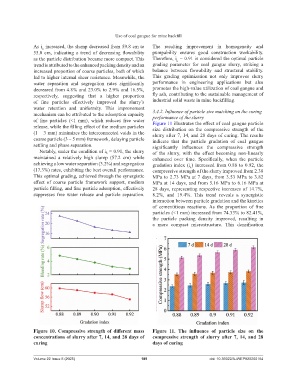
                                                                    Figure 11 illustrates the effect of coal gangue particle
                release, while the filling effect of the medium particles   size  distribution  on  the  compressive  strength  of  the
                (1 – 3 mm) minimizes the interconnected voids in the   slurry after 7, 14, and 28 days of curing. The results
                coarse particle (3 – 5 mm) framework, delaying particle   indicate  that  the  particle  gradation  of  coal  gangue
                settling and phase separation.                      significantly  influences  the  compressive  strength
                  Notably, under the condition of iₖ = 0.91, the slurry   of  the  slurry,  with  the  effect  becoming  non-linearly
                maintained  a  relatively  high  slump  (57.2  cm)  while   enhanced  over  time.  Specifically,  when  the  particle
                achieving a low water separation (3.2%) and segregation   gradation index (i ) increased from 0.88 to 0.92, the
                                                                                     k
                (17.3%) rates, exhibiting the best overall performance.   compressive strength of the slurry improved from 2.38
                This optimal grading, achieved through the synergistic   MPa to 2.73 MPa at 7 days, from 3.53 MPa to 3.82
                effect  of  coarse  particle  framework  support,  medium   MPa at 14 days, and from 5.16 MPa to 6.16 MPa at
                particle filling, and fine particle adsorption, effectively   28 days, representing respective increases of 14.7%,
                suppresses  free  water  release  and  particle  separation.   8.2%,  and  19.4%.  This  trend  reveals  a  synergistic
                                                                    interaction between particle gradation and the kinetics
                                                                    of  cementitious  reactions. As  the  proportion  of  fine
                                                                    particles (<1 mm) increased from 74.33% to 82.41%,
                                                                    the  particle  packing  density  improved,  resulting  in
                                                                    a  more  compact  microstructure.  This  densification


                Figure  10.  Compressive  strength  of  different  mass   Figure  11.  The  influence  of  particle  size  on  the
                concentrations of slurry after 7, 14, and 28 days of   compressive  strength  of  slurry  after  7,  14,  and  28
                curing                                              days of curing


                Volume 22 Issue 5 (2025)                       189                           doi: 10.36922/AJWEP025200154

