


Page 192 - AJWEP-22-5
P. 192
Hou, et al.

                is  achieved  when  the  slump  spread  is  about  50  cm   network  that  strengthens  the  interparticle  interactions
                and  plastic  viscosity  remains  below  0.25  Pa·s.  In   and minimizes the availability of free water. Notably,
                this study, coal gangue slurry satisfied these criteria   once  the  mass  concentration  exceeds  72%,  the  yield
                only  between  68%  and  72%  solids.  Above  72%,   stress exhibits a more pronounced growth rate, while
                the  increasing  viscosity  could  pose  challenges  in   the water bleeding rate drops to a minimal level. This
                practical construction applications, such as difficulty   phenomenon  can  be  explained  by  the  formation  of  a
                in pipeline transportation, higher energy consumption   more  compact  particle  skeleton,  which  increases  the
                during pumping, and potential clogging.  Therefore,   slurry’s  cohesive  forces  and  reduces  the  number  of
                                                     31
                from  both  theoretical  and  practical  standpoints,   water  migration  pathways.  The  higher  solid  fraction
                optimizing  the  mass  concentration  of  coal  gangue   effectively binds the free water within the slurry matrix,
                slurry  becomes  essential  to  balance  flowability  and   mitigating  the  risk  of  excessive  bleeding.  However,
                structural stability.                               while a higher mass concentration improves stability,
                                                                    it also introduces potential challenges. Excessive yield
                3.3.2. Influence of solid concentration on slurry   stress may hinder the workability and pumpability of
                stability                                           the  slurry,  leading  to  increased  energy  consumption
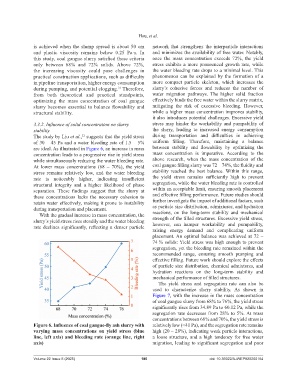
                The study by Liu et al.,  suggests that the yield stress   during  transportation  and  difficulties  in  achieving
                                     32
                of 30 – 45 Pa and a water bleeding rate of 1.5 – 5%   uniform  filling.  Therefore,  maintaining  a  balance
                are ideal. As illustrated in Figure 6, an increase in mass   between  stability  and  flowability  by  optimizing  the
                concentration leads to a progressive rise in yield stress   mass  concentration  is  imperative.  According  to  the
                while simultaneously reducing the water bleeding rate.   above  research,  when  the  mass  concentration  of  the
                At  lower  mass  concentrations  (68  –  70%),  the  yield   coal gangue filling slurry was 72 – 74%, the fluidity and
                stress  remains  relatively  low,  and  the  water  bleeding   stability  reached  the  best  balance.  Within  this  range,
                rate  is  noticeably  higher,  indicating  insufficient   the  yield  stress  remains  sufficiently  high  to  prevent
                structural  integrity  and  a  higher  likelihood  of  phase   segregation, while the water bleeding rate is controlled
                separation.  These  findings  suggest  that  the  slurry  at   within an acceptable limit, ensuring smooth placement
                these  concentrations  lacks  the  necessary  cohesion  to   and effective filling performance. Future studies should
                retain water effectively, making it prone to instability   further investigate the impact of additional factors, such
                during transportation and placement.                as particle size distribution, admixtures, and hydration
                  With the gradual increase in mass concentration, the   reactions,  on  the  long-term  stability  and  mechanical
                slurry’s yield stress rises steadily and the water bleeding   strength of the filled structures. Excessive yield stress,
                rate  declines  significantly,  reflecting  a  denser  particle   however,  can  hamper  workability  and  pumpability,
                                                                    raising  energy  demand  and  complicating  uniform
                                                                    placement. An  optimal balance  was  achieved  at  72  –
                                                                    74 % solids: Yield stress was high enough to prevent
                                                                    segregation, yet the bleeding rate remained within the
                                                                    recommended  range,  ensuring  smooth  pumping  and
                                                                    effective filling. Future work should explore the effects
                                                                    of particle size distribution, chemical admixtures, and
                                                                    hydration  reactions  on  the  long-term  stability  and
                                                                    mechanical performance of filled structures.
                                                                       The  yield  stress  and  segregation  rate  can  also  be
                                                                    used  to  characterize  slurry  stability.  As  shown  in
                                                                    Figure 7, with the increase in the mass concentration
                                                                    of coal gangue slurry from 68% to 76%, the yield stress
                                                                    significantly rises from 34.89 Pa to 60.12 Pa, while the
                                                                    segregation rate decreases from 28% to 5%. At mass
                                                                    concentrations between 68% and 70%, the yield stress is
                Figure 6. Influence of coal gangue‑fly ash slurry with   relatively low (<41 Pa), and the segregation rate remains
                varying  mass  concentrations  on  yield  stress  (blue   high (20 – 28%), indicating weak particle interactions,
                line, left axis) and bleeding rate (orange line, right   a  loose  structure,  and  a  high  tendency  for  free  water
                axis)                                               migration, leading to significant segregation and poor


                Volume 22 Issue 5 (2025)                       186                           doi: 10.36922/AJWEP025200154

