


Page 213 - AJWEP-22-5
P. 213
Knowledge into practice: Managing bio-waste

                for comprehensive data analysis. Descriptive statistics   Table 1. Demographic characteristics of the
                were used to summarize the data, with results presented   participants
                as frequencies and percentages. The chi-square test was   Characteristics     n (total=163) Percentage
                applied to determine the association between categorical   Age (years)
                variables.
                                                                      20 – 30                      29         17.8
                3. Results                                            30 – 40                      61         37.4
                                                                      40 – 50                      48         29.4
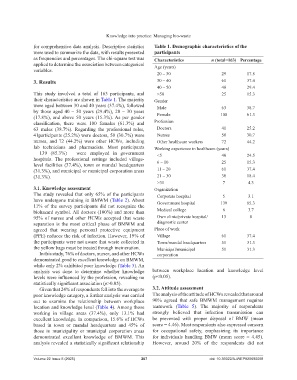
                This  study involved  a  total  of 163 participants,  and   >50                    25         15.3
                their characteristics are shown in Table 1. The majority   Gender
                were aged between 30 and 40 years (37.4%), followed   Male                         63         38.7
                by those aged 40 – 50  years (29.4%), 20 – 30  years
                (17.8%), and above 50 years (15.3%). As per gender    Female                      100         61.3
                classification,  there  were  100  females  (61.3%)  and   Profession
                63  males (38.7%). Regarding the professional roles,   Doctors                     41         25.2
                41participants (25.2%) were doctors, 50 (30.7%) were   Nurses                      50         30.7
                nurses, and 72  (44.2%) were other HCWs, including    Other healthcare workers     72         44.2
                lab technicians  and pharmacists.  Most participants   Working experience in healthcare (years)
                – 139  (85.3%) – were  employed  in  government       <5                           40         24.5
                hospitals.  The  professional  settings  included  village-
                level facilities (37.4%), town or mandal headquarters   6 – 10                     25         15.3
                (31.3%), and municipal or municipal corporation areas   11 – 20                    61         37.4
                (31.3%).                                              21 – 30                      30         18.4
                                                                      >31                          7          4.3
                3.1. Knowledge assessment                            Organization
                The study revealed  that only 65% of the participants   Corporate hospital         5          3.1
                have undergone training in BMWM (Table 2). About
                11% of the  survey participants  did  not recognize  the   Government hospital    139         85.3
                biohazard symbol. All doctors (100%) and more than    Medical college              6          3.7
                95% of nurses and other HCWs accepted  that  waste    Own clinic/private hospital/  13         8
                separation  is the  most  critical  phase  of BMWM and   diagnostic center
                agreed  that  wearing  personal  protective  equipment   Place of work
                (PPE) reduces the risk of infection. However, 19% of   Village                     61         37.4
                the participants were not aware that waste collected in   Town/mandal headquarters  51        31.3
                the yellow bags must be treated through incineration.  Municipal/municipal         51         31.3
                  In this study, 76% of doctors, nurses, and other HCWs   corporation
                demonstrated good to excellent knowledge on BMWM,
                while only 2% exhibited poor knowledge (Table 3). An
                analysis was done to determine  whether knowledge   between  workplace  location and knowledge  level
                levels were influenced by the profession, revealing no   (p<0.05).
                statistically significant association (p>0.05).
                  Given that 24% of respondents fell into the average to   3.2. Attitude assessment
                poor knowledge category, a further analysis was carried   The analysis of the attitude of HCWs revealed that around
                out to examine  the relationship  between workplace   90% agreed that safe BMWM management  requires
                location and knowledge level (Table 4). Among those   teamwork (Table  5).  The majority  of respondents
                working in village  areas  (37.4%), only 13.1% had   strongly believed  that  infection  transmission  can
                excellent knowledge. In comparison, 15.6% of HCWs   be  prevented  with  proper  disposal  of BMW (mean
                based in town or mandal  headquarters and 45% of    score = 4.46). Most respondents also expressed concern
                those in municipality  or municipal  corporation areas   for occupational safety, emphasizing  its importance
                demonstrated  excellent  knowledge of BMWM.  This   for individuals handling BMW (mean score = 4.45).
                analysis revealed a statistically significant relationship   However, around 20% of the respondents did not


                Volume 22 Issue 5 (2025)                       207                           doi: 10.36922/AJWEP025090058

