


Page 215 - AJWEP-22-5
P. 215
Knowledge into practice: Managing bio-waste

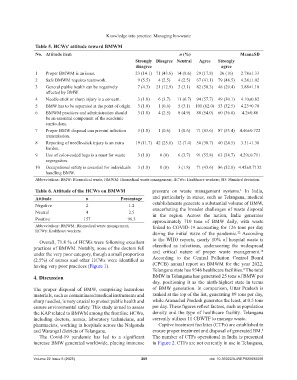
                 Table 5. HCWs’ attitude toward BMWM
                 No. Attitude item                                              n (%)                      Mean±SD
                                                             Strongly  Disagree Neutral  Agree   Strongly
                                                             disagree                             agree
                 1   Proper BMWM is an issue.                23 (14.1) 71 (43.6) 14 (8.6)  29 (17.8)  26 (16)  2.78±1.33
                 2   Safe BMWM requires teamwork.             9 (5.5)  4 (2.5)  4 (2.5)  67 (41.1)  79 (48.5)  4.24±1.02
                 3   General public health can be negatively   7 (4.3)  21 (12.9)  5 (3.1)  82 (50.3)  48 (29.4)  3.88±1.10
                     affected by BMW.
                 4   Needle-stick or sharp injury is a concern.  3 (1.8)  6 (3.7)  11 (6.7)  94 (57.7)  49 (30.1)  4.10±0.82
                 5   BMW has to be separated at the point of origin.  3 (1.8)  1 (0.6)  5 (3.1)  101 (62.0) 53 (32.5)  4.23±0.70
                 6   BMWM practices and administration should   3 (1.8)  4 (2.5)  8 (4.9)  88 (54.0)  60 (36.8)  4.2±0.80
                     be an essential component of the academic
                     curriculum.
                 7   Proper BMW disposal can prevent infection   3 (1.8)  1 (0.6)  1 (0.6)  71 (43.6)  87 (53.4)  4.46±0.722
                     transmission.
                 8   Reporting of needle-stick injury is an extra   19 (11.7) 42 (25.8) 12 (7.4)  50 (30.7)  40 (24.5)  3.31±1.38
                     burden.
                 9   Use of color-coded bags is a must for waste   3 (1.8)  0 (0)  6 (3.7)  91 (55.8)  63 (38.7)  4.29±0.711
                     segregation.
                 10  Occupational safety is essential for individuals   3 (1.8)  0 (0)  3 (1.8)  71 (43.6)  86 (52.8) 4.45±0.7132
                     handling BMW.
                 Abbreviations: BMW: Biomedical waste; BMWM: Biomedical waste management; HCWs: Healthcare workers; SD: Standard deviation.

                 Table 6. Attitude of the HCWs on BMWM              pressure on waste management systems.  In India,
                                                                                                           1
                 Attitude              n              Percentage    and particularly in states, such as Telangana, medical
                 Negative              2                  1.2       establishments generate a substantial volume of BMW,
                 Neutral               4                  2.5       exacerbating the broader challenges of waste disposal
                                                                    in the region.  Across the nation,  India generates
                 Positive             157                96.3       approximately  710 tons of BMW daily, with waste
                 Abbreviations: BMWM: Biomedical waste management;   linked to COVID-19 accounting for 126 tons per day
                 HCWs: Healthcare workers.
                                                                    during the initial wave of the pandemic.  According
                                                                                                          22
                                                                    to the WHO reports, nearly 10% of hospital waste is
                  Overall, 71.8 % of HCWs were following excellent
                practices of BMWM. Notably, none of the doctors fell   classified  as  infectious,  underscoring  the  widespread
                                                                                                                    14
                under the very poor category, though a small proportion   and critical  nature  of proper waste management.
                (2.5%)  of  nurses  and  other  HCWs  were  identified  as   According to the Central  Pollution  Control Board
                having very poor practices (Figure 1).              (CPCB) annual report on BMWM for the year 2022,
                                                                    Telangana state has 9346 healthcare facilities.  The total
                                                                                                            4
                4. Discussion                                       BMW in Telangana has generated 25 tons of BMW per
                                                                    day, positioning it as the ninth-highest state in terms
                The proper disposal of BMW, comprising hazardous    of BMW generation. In comparison, Uttar Pradesh is
                materials, such as contaminated medical instruments and   ranked at the top of the list, generating 89 tons per day,
                sharp needles, is very crucial to protect public health and   while Arunachal Pradesh generates the least, at 0.5 tons
                ensure environmental safety. This study aimed to assess   per day. These figures reflect factors, such as population
                the KAP related to BMWM among the frontline HCWs,   density  and  the  type  of healthcare  facility. Telangana
                including  doctors, nurses, laboratory  technicians,  and   currently utilizes 11 CBWTF to manage waste.
                pharmacists, working in hospitals across the Nalgonda   Captive treatment facilities (CTFs) are established to
                and Warangal districts of Telangana.                ensure proper treatment and disposal of generated BM.
                                                                                                                    4
                  The  Covid-19  pandemic  has  led  to  a  significant   The number of CTFs operational in India is presented
                increase BMW generated worldwide, placing immense   in Figure 2. CTFs are not currently in use in Telangana,


                Volume 22 Issue 5 (2025)                       209                           doi: 10.36922/AJWEP025090058

