


Page 217 - AJWEP-22-5
P. 217
Knowledge into practice: Managing bio-waste

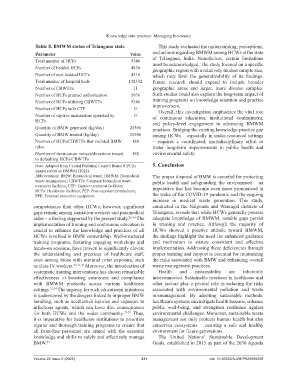
                 Table 8. BMWM status of Telangana state               This study evaluated the understanding, perceptions,
                 Parameter                                Value     and actions regarding BMWM among HCWs in the state
                 Total number of HCFs                      9346     of  Telangana, India. Nonetheless, certain  limitations
                                                                    must be acknowledged. The study focused on a specific
                 Number of bedded HCFs                     4830     geographic region with a relatively modest sample size,
                 Number of non-bedded HCFs                 4516     which  may  limit  the  generalizability  of  its  findings.
                 Total number of hospital beds            132332    Future research should expand to include  broader
                 Number of CBWTFs                           11      geographic areas and larger, more diverse samples.
                 Number of HCFs granted authorization      5036     Such studies could also explore the long-term impact of
                 Number of HCFs utilizing CBWTFs           9346     training programs on knowledge retention and practice
                 Number of HCFs with CTF                    0       improvement.
                                                                       Overall, this investigation emphasizes the vital role
                 Number of captive incinerators operated by   0     of continuous education, institutional  commitment,
                 HCFs                                               and policy-level  engagement  in advancing  BMWM
                 Quantity of BMW generated (kg/day)       25306     practices. Bridging the existing knowledge-practice gap
                 Quantity of BMW treated (kg/day)         25306     among HCWs – especially in under-resourced settings
                 Number of HCFs/CBWTFs that violated BMW   188      –  requires  a  coordinated,  multidisciplinary  effort  to
                 rules                                              foster long-term  improvements  in public  health  and
                 Number of show-cause notices/directions issued   188  environmental safety.
                 to defaulting HCFs/CBWTFs
                 Note: Adapted from Central Pollution Control Board (CPCB)   5. Conclusion
                 annual report on BMWM (2022).
                 Abbreviations: BMW: Biomedical waste; BMWM: Biomedical   The proper disposal of BMW is essential for protecting
                 waste management; CBWTFs: Common biomedical waste   public health and safeguarding the environment  – an
                 treatment facilities; CTF: Captive treatment facilities;
                 HCFs: Healthcare facilities; PEP: Post-exposure prophylaxis;   imperative that has become even more pronounced in
                 PPE: Personal protective equipment.                the wake of the COVID-19 pandemic and the ongoing
                                                                    increase in medical  waste generation.  This study,
                competencies  than  other  HCWs;  however,  significant   conducted in the Nalgonda and  Warangal districts of
                gaps remain among sanitation workers and paramedical   Telangana, reveals that while HCWs generally possess
                aides – a finding supported by the present study. 26-30  The   adequate knowledge of BMWM, notable gaps persist
                implementation of training and continuous education is   in  training  and  practice.  Although  the  majority  of
                crucial to enhance the knowledge and practices of all   HCWs showed  a positive attitude  toward BMWM,
                HCWs involved in BMW stewardship. Well-structured   the findings highlight the need for enhanced guidance
                training programs, featuring engaging workshops and   and  motivation  to  ensure  consistent  and  effective
                hands-on sessions, have proven to significantly elevate   implementation. Addressing these deficiencies through
                the  understanding  and  practices  of  healthcare  staff,   proper training and support is essential for minimizing
                even among those with minimal prior exposure, such   the risks associated with BMW and enhancing overall
                as class IV workers. 23,31-32  Moreover, the introduction of   waste management practices.
                systematic training interventions has shown remarkable   Health  and   sustainability  are  inherently
                effectiveness  in  boosting  awareness  and  compliance   interconnected. Sustainable practices in healthcare and
                with BMWM protocols across various healthcare       other sectors play a pivotal role in reducing the risks
                settings. 33,34  The urgency for such educational initiatives   associated  with environmental pollution  and waste
                is underscored by the dangers linked to improper BMW   mismanagement.  By adopting  sustainable  methods,
                handling, such as needlestick injuries and exposure to   healthcare systems can mitigate health hazards, enhance
                infectious  agents, which can have dire  consequences   public well-being, and strengthen resilience  against
                for  both  HCWs and  the  wider  community. 35-37  Thus,   environmental challenges. Moreover, sustainable waste
                it is imperative for healthcare institutions to prioritize   management not only protects human health but also
                regular and thorough training programs to ensure that   conserves ecosystems  – ensuring a safe and healthy
                all  front-line  personnel  are armed  with the essential   environment for future generations.
                knowledge and skills to safely and effectively manage   The United  Nations’ Sustainable Development
                BMW.  23                                            Goals, established in 2015 as part of the 2030 Agenda


                Volume 22 Issue 5 (2025)                       211                           doi: 10.36922/AJWEP025090058

