


Page 214 - AJWEP-22-5
P. 214
Suram, et al.

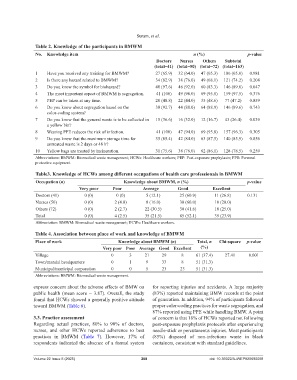
                 Table 2. Knowledge of the participants in BMWM
                 No.  Knowledge item                                                  n (%)                   p‑value
                                                                      Doctors   Nurses    Others    Subtotal
                                                                     (total=41) (total=50) (total=72) (total=163)
                 1    Have you received any training for BMWM?        27 (65.9)  32 (64.0)  47 (65.3)  106 (65.0)  0.981
                 2    Is there any hazard related to BMWM?            34 (82.9)  38 (76.0)  49 (68.1)  121 (74.2)  0.208
                 3    Do you know the symbol for biohazard?           40 (97.6)  46 (92.0)  60 (83.3)  146 (89.6)  0.047
                 4    The most important aspect of BMWM is segregation.  41 (100)  49 (98.0)  69 (95.8)  159 (97.5)  0.376
                 5    PEP can be taken at any time.                   20 (48.8)  22 (44.0)  35 (48.6)  77 (47.2)  0.859
                 6    Do you know about segregation based on the      38 (92.7)  44 (88.0)  64 (88.9)  146 (89.6)  0.743
                      color-coding system?
                 7    Do you know that the general waste is to be collected in   15 (36.6)  16 (32.0)  12 (16.7)  43 (26.4)  0.039
                      a yellow bin?
                 8    Wearing PPE reduces the risk of infection.      41 (100)  47 (94.0)  69 (95.8)  157 (96.3)  0.305
                 9    Do you know that the maximum storage time for   35 (85.4)  42 (84.0)  63 (87.5)  140 (85.9)  0.856
                      untreated waste is 2 days or 48 h?
                 10   Yellow bags are treated by incineration.        31 (75.6)  38 (76.0)  62 (86.1)  128 (78.5)  0.259
                 Abbreviations: BMWM: Biomedical waste management; HCWs: Healthcare workers; PEP: Post-exposure prophylaxis; PPE: Personal
                 protective equipment.

                 Table3. Knowledge of HCWs among different occupations of health care professionals in BMWM
                 Occupation (n)                         Knowledge about BMWM, n (%)                           p‑value
                                    Very poor      Poor         Average        Good            Excellent
                 Doctors (41)         0 (0)         0 (0)        5 (12.1)       25 (60.9)       11 (26.8)     0.131
                 Nurses (50)          0 (0)         2 (4.0)      8 (16.0)       30 (60.0)      10 (20.0)
                 Others (72)          0 (0)         2 (2.7)      22 (30.5)      30 (41.6)      18 (25.0)
                 Total                0 (0)         4 (2.5)      35 (21.5)      85 (52.1)      39 (23.9)
                 Abbreviation: BMWM: Biomedical waste management; HCWs: Healthcare workers.

                 Table 4. Association between place of work and knowledge of BMWM
                 Place of work                       Knowledge about BMWM (n)           Total, n   Chi‑square  p‑value
                                              Very poor Poor Average Good Excellent      (%)
                 Village                          0       3      21     29       8     61 (37.4)    27.41      0.001
                 Town/mandal headquarters         0       1      9      33       8     51 (31.3)
                 Municipal/municipal corporation  0       0      5      23      23     51 (31.3)
                 Abbreviations: BMWM: Biomedical waste management.

                express concern about the adverse effects of BMW on   for reporting  injuries  and accidents. A  large majority
                public health (mean score = 3.87). Overall, the study   (83%) reported maintaining BMW records at the point
                found that HCWs showed a generally positive attitude   of generation. In addition, 94% of participants followed
                toward BMWM (Table 6).                              proper color-coding practices for waste segregation, and
                                                                    87% reported using PPE while handling BMW. A point
                3.3. Practice assessment                            of concern is that 18% of HCWs reported not following
                Regarding  actual  practices,  80% to 90% of doctors,   post-exposure prophylaxis protocols after experiencing
                nurses, and other  HCWs reported  adherence  to best   needle-stick or percutaneous injuries. Most participants
                practices in BMWM  (Table  7).  However,  17%  of   (85%) disposed of non-infectious  waste  in black
                respondents indicated the absence of a formal system   containers, consistent with standard guidelines.


                Volume 22 Issue 5 (2025)                       208                           doi: 10.36922/AJWEP025090058

