


Page 224 - AJWEP-22-5
P. 224
Liu, et al.

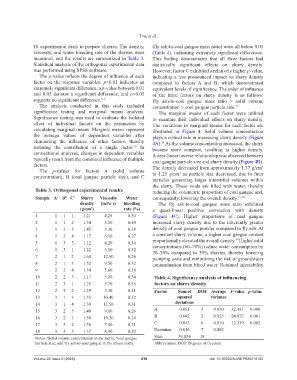
                18 experimental trials to prepare slurries. The density,   (fly ash-to-coal gangue mass ratio) were all below 0.01
                viscosity, and water bleeding rate of the slurries were   (Table 4), indicating extremely significant differences.
                measured, and the results are summarized in Table 3.   This  finding  demonstrates  that  all  three  factors  had
                Statistical analysis of the orthogonal experimental data   statistically  significant  effects  on  slurry  density.
                was performed using SPSS software.                  However, factor C exhibited a relatively higher p-value,
                  The p-value reflects the degree of influence of each   indicating a less pronounced impact on slurry density
                factor  on  the  response  variables:  p<0.01  indicates  an   compared  to  factors  A  and  B,  which  demonstrated
                extremely significant difference, a p-value between 0.01   equivalent levels of significance. The order of influence
                and  0.05  denotes  a  significant  difference,  and  p>0.05   of  the  three  factors  on  slurry  density  is  as  follows:
                suggests no significant difference. 9-11            Fly  ash-to-coal  gangue  mass  ratio  >  solid  volume
                  The  analysis  conducted  in  this  study  included   concentration > coal gangue particle size. 13
                significance  testing  and  marginal  means  analysis.   The  marginal  means  of  each  factor  were  utilized
                Significance testing was used to evaluate the isolated   to  examine  their  individual  effects  on  slurry  density.
                effect  of  individual  factors  on  the  parameters  by   The  variations  in  marginal  means  for  each  factor  are
                calculating marginal means. Marginal means represent   illustrated  in  Figure  4. Solid volume  concentration
                the  average  values  of  dependent  variables  after   plays a critical role in increasing slurry density (Figure
                eliminating  the  influence  of  other  factors,  thereby   4A).  As the volume concentration increased, the slurry
                                                                        14
                isolating  the  contribution  of  a  single  factor.   In   became  more  compact,  resulting  in  higher  density.
                                                            12
                conventional analyses, changes in dependent variables   A near-linear inverse relationship was observed between
                typically result from the combined influence of multiple   coal gangue particle size and slurry density (Figure 4B).
                factors.                                            The density decreased from approximately 1.37 g/cm
                                                                                                                    3
                  The  p-values  for  factors  A  (solid  volume                3
                concentration),  B  (coal  gangue  particle  size),  and  C   to 1.25  g/cm   as  particle  size  decreased,  due  to  finer
                                                                    particles  generating  larger  interstitial  volumes  within
                                                                    the  slurry.  These  voids  are  filled  with  water,  thereby
                 Table 3. Orthogonal experimental results           reducing the volumetric proportion of coal gangue and,
                 Sample A a  B b  C c  Slurry   Viscosity   Water   consequently, lowering the overall density. 15-18
                                    density   (mPa·s)   bleeding       The  fly  ash-to-coal  gangue  mass  ratio  exhibited
                                    (g/cm )            rate (%)     a  quasi-linear  positive  correlation  with  density
                                         3
                 1       1   1   1    1.21     4.25      0.34       (Figure  4C).  Higher  proportions  of  coal  gangue
                 2       1   1   2    1.34     5.10      0.40       increased  slurry  density  due  to  the  inherently  greater
                 3       1   2   3    1.45     5.30      0.38       density of coal gangue powder compared to fly ash. At
                 4       1   2   4    1.17     6.10      0.37       a constant slurry volume, a higher coal gangue content
                                                                                                         19
                 5       1   3   5    1.12     4.20      0.34       proportionally elevated the overall density.  Higher solid
                 6       1   3   1    1.22     5.10      0.32       concentrations (60–70%) reduce water consumption by
                                                                    20–30%  compared  to  50%  slurries,  thereby  lowering
                 7       2   1   2    1.60     12.50     0.26       pumping costs and minimizing the risk of groundwater
                 8       2   1   3    1.52     9.50      0.32       contamination from bleed water. Retained injectability
                 9       2   2   4    1.34     5.60      0.38
                 10      2   2   5    1.17     5.10      0.34        Table 4. Significance analysis of influencing
                 11      2   3   1    1.25     5.70      0.35        factors on slurry density
                 12      2   3   2    1.29     5.30      0.31        Factor    Sum of   DOF Average  F‑value p‑value
                 13      3   1   3    1.35     10.40     0.32                  squared        variance
                 14      3   1   4    1.30     11.50     0.31                 deviations
                 15      3   2   5    1.40     9.10      0.26        A          0.051     3    0.030   32.481  0.000
                 16      3   2   1    1.50     10.20     0.24        B          0.042     2    0.025   24.972  0.001
                 17      3   3   2    1.38     7.40      0.31        C          0.043     6    0.010   12.339  0.002
                 18      3   3   3    1.37     8.10      0.32        Deviation  0.016     7    0.002
                 Notes:  Solid volume concentration in the slurry;  coal gangue   Sum  30.036  18
                                                    b
                      a
                 particle size; and  fly ash-to-coal gangue in the mixed slurry.  Abbreviation: DOF: Degrees of freedom.
                             c
                Volume 22 Issue 5 (2025)                       218                           doi: 10.36922/AJWEP025210162

