


Page 229 - AJWEP-22-5
P. 229
Rheological properties of coal gangue slurry

                                                                    coal gangue particles under shear temporarily reduced
                                                                    internal friction, thereby improving fluidity. However,
                                                                    this effect is often limited due to the inherent high water
                                                                    absorption and fine particle characteristics of fly ash.
                                                                       Figure  10  shows  the  variation  curves  of  the  water
                                                                    bleeding  rate  of  slurries  with  a  70%  solid  volume
                                                                    concentration under different pressure conditions. The
                                                                    results  demonstrated  that  higher  pressure  accelerated
                                                                    water  bleeding  and  shortened  the  time  required  to
                                                                    complete  the  process,  exhibiting  an  approximately
                                                                    linear relationship between bleeding rate and pressure.
                                                                    Finer  coal  gangue  particle  sizes  reduced  the  water
                                                                    bleeding rate and prolonged the precipitation process of
                                                                    the slurry.
                                                                       As the fly ash-to-coal gangue mass ratio decreased,
                                                                    the  time  required  to  complete  bleeding  increased,
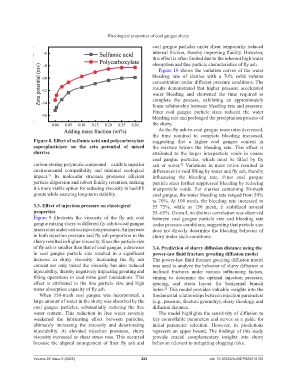
                Figure 8. Effect of sulfamic acid and polycarboxylate   suggesting  that  a  higher  coal  gangue  content  in
                superplasticizer  on  the  zeta  potential  of  mixed   the  mixture  lowers  the  bleeding  rate.  This  effect  is
                slurries                                            attributed  to  the  larger  interparticle  voids  in  coarse
                                                                    coal  gangue  particles,  which  must  be  filled  by  fly
                carbon-storing polymeric compound—exhibits superior   ash  or  water.   Variations  in  mass  ratios  resulted  in
                                                                                22
                environmental  compatibility  and  minimal  ecological   differences in void filling by water and fly ash, thereby
                impact.   Its  molecular  structure  promotes  efficient   influencing  the  bleeding  rate.  Finer  coal  gangue
                      31
                particle dispersion and robust fluidity retention, making   particle sizes further suppressed bleeding by reducing
                it a more viable option for reducing viscosity in backfill   interparticle  voids.  For  slurries  containing  50-mesh
                grouts while ensuring long-term stability.          coal gangue, the water bleeding rate ranged from 50%
                                                                    to 70%. At 100 mesh, the bleeding rate increased to
                3.3. Effect of injection pressure on rheological    55–75%,  while  at  150  mesh,  it  stabilized  around
                properties                                          55–65%. Overall, no distinct correlation was observed
                Figure  9  illustrates  the  viscosity  of  the  fly  ash–coal   between  coal  gangue  particle  size  and  bleeding  rate
                gangue mixing slurry at different fly ash-to-coal gangue   under pressure conditions, suggesting that particle size
                mass ratios under various injection pressures. An increase   does not directly determine the bleeding behavior of
                in both injection pressure and fly ash proportion in the   slurry under such conditions.
                slurry resulted in higher viscosity. Since the particle size
                of fly ash is smaller than that of coal gangue, a decrease   3.4. Prediction of slurry diffusion distance using the
                in  coal  gangue  particle  size  resulted  in  a  significant   power‑law fluid fracture grouting diffusion model
                increase  in  slurry  viscosity.  Increasing  the  fly  ash   The power-law fluid fracture grouting diffusion model
                content not only raised the viscosity but also reduced   was used to analyze the behavior of slurry diffusion in
                injectability, thereby negatively impacting grouting and   inclined  fractures  under  various  influencing  factors,
                filling operations in coal mine goaf foundations. This   aiming  to  determine  the  optimal  injection  pressure,
                effect  is  attributed  to  the  fine  particle  size  and  high   spacing,  and  strata  layout  for  horizontal  branch
                water absorption capacity of fly ash.               holes.  This model provides valuable insights into the
                                                                         22
                  When  150-mesh  coal  gangue  was  incorporated,  a   fundamental relationships between injection parameters
                large amount of water in the slurry was absorbed by the   (e.g., pressure, fracture geometry), slurry rheology, and
                coal  gangue  particles,  substantially  reducing  the  free   diffusion distance.
                water  content.  This  reduction  in  free  water  severely   The model highlights the sensitivity of diffusion to
                weakened  the  lubricating  effect  between  particles,   key controllable parameters and serves as a guide for
                ultimately  increasing  the  viscosity  and  deteriorating   initial  parameter  selection.  However,  its  predictions
                injectability.  At  elevated  injection  pressures,  slurry   represent  an  upper  bound. The  findings  of  this  study
                viscosity increased as shear stress rose. This occurred   provide  crucial  complementary  insights  into  slurry
                because  the  aligned  arrangement  of  finer  fly  ash  and   behavior relevant to mitigating clogging risks.


                Volume 22 Issue 5 (2025)                       223                           doi: 10.36922/AJWEP025210162

