


Page 225 - AJWEP-22-5
P. 225
Rheological properties of coal gangue slurry

                              A                                    B


                              C


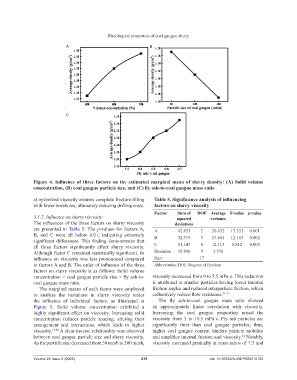
                Figure 4. Influence of three factors on the estimated marginal mean of slurry density: (A) Solid volume
                concentration, (B) coal gangue particle size, and (C) fly ash‑to‑coal gangue mass ratio


                at optimized viscosity ensures complete fracture filling   Table 5. Significance analysis of influencing
                with fewer boreholes, ultimately reducing drilling costs.  factors on slurry viscosity

                                                                     Factor    Sum of   DOF Average  F‑value p‑value
                3.1.2. Influence on slurry viscosity                           squared        variance
                The influences of the three factors on slurry viscosity       deviations
                are  presented  in Table  5. The  p-values  for  factors A,   A  42.833  2    20.432   17.333  0.001
                B,  and  C  were  all  below  0.01,  indicating  extremely   B  32.375   3    17.685   12.163  0.002
                significant  differences. This  finding  demonstrates  that
                all  three  factors  significantly  affect  slurry  viscosity.   C  51.147  6  12.113  8.812   0.003
                Although factor C remained statistically significant, its   Deviation  15.896  9  3.576
                influence on viscosity was less pronounced compared   Sum                17
                to factors A and B. The order of influence of the three   Abbreviation: DOF: Degrees of freedom.
                factors on slurry viscosity is as follows: Solid volume
                concentration > coal gangue particle size > fly ash-to-  viscosity decreased from 9 to 5.5 mPa·s. This reduction
                coal gangue mass ratio.                             is attributed to smaller particles having lower internal
                  The marginal means of each factor were employed   friction angles and reduced interparticle friction, which
                to  analyze  the  variations  in  slurry  viscosity  under   collectively reduce flow resistance. 21-23
                the  influence  of  individual  factors,  as  illustrated  in   The  fly  ash-to-coal  gangue  mass  ratio  showed
                Figure  5.  Solid  volume  concentration  exhibited  a   an  approximately  linear  correlation  with  viscosity.
                highly significant effect on viscosity. Increasing solid   Increasing  the  coal  gangue  proportion  raised  the
                concentration  reduces  particle  spacing,  altering  their   viscosity  from  5  to  10.5  mPa·s.  Fly  ash  particles  are
                arrangement  and  interactions,  which  leads  to  higher   significantly  finer  than  coal  gangue  particles;  thus,
                viscosity. 19,20  A clear inverse relationship was observed   higher  coal  gangue  content  hinders  particle  mobility
                between coal gangue particle size and slurry viscosity.   and amplifies internal friction and viscosity.  Notably,
                                                                                                           24
                As the particle size decreased from 50 mesh to 200 mesh,   viscosity increased gradually at mass ratios of 7:3 and


                Volume 22 Issue 5 (2025)                       219                           doi: 10.36922/AJWEP025210162

