


Page 226 - AJWEP-22-5
P. 226
Liu, et al.

                               A                                   B


                               C


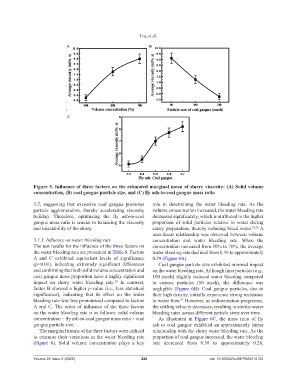
                Figure 5. Influence of three factors on the estimated marginal mean of slurry viscosity: (A) Solid volume
                concentration, (B) coal gangue particle size, and (C) fly ash‑to‑coal gangue mass ratio

                3:7,  suggesting  that  excessive  coal  gangue  promotes   role  in  determining  the  water  bleeding  rate.  As  the
                particle  agglomeration,  thereby  accelerating  viscosity   volume concentration increased, the water bleeding rate
                buildup.  Therefore,  optimizing  the  fly  ash-to-coal   decreased significantly, which is attributed to the higher
                gangue mass ratio is crucial to balancing the viscosity   proportion  of  solid  particles  relative  to  water  during
                and injectability of the slurry.                    slurry preparation, thereby reducing bleed water. 25,26  A
                                                                    near-linear relationship was observed between volume
                3.1.3. Influence on water bleeding rate             concentration  and  water  bleeding  rate.  When  the
                The test results for the influence of the three factors on   concentration increased from 50% to 70%, the average
                the water bleeding rate are presented in Table 6. Factors   water bleeding rate declined from 0.39 to approximately
                A  and  C  exhibited  equivalent  levels  of  significance   0.29 (Figure 6A).
                (p<0.01),  indicating  extremely  significant  differences   Coal gangue particle size exhibited minimal impact
                and confirming that both solid volume concentration and   on the water bleeding rate. Although finer particles (e.g.,
                coal gangue mass proportion have a highly significant   100  mesh)  slightly  reduced  water  bleeding  compared
                impact  on  slurry  water  bleeding  rate.   In  contrast,   to  coarser  particles  (50  mesh),  the  difference  was
                                                    24
                factor B showed a higher p-value (i.e., less statistical   negligible  (Figure  6B).  Coal  gangue  particles,  due  to
                significance),  indicating  that  its  effect  on  the  water   their high density, initially experience strong resistance
                bleeding rate was less pronounced compared to factors   to water flow.  However, as sedimentation progresses,
                                                                                27
                A  and  C.  The  order  of  influence  of  the  three  factors   the settling velocity decreases, resulting in similar water
                on the water bleeding rate is as follows: solid volume   bleeding rates across different particle sizes over time.
                concentration = fly ash-to-coal gangue mass ratio > coal   As  illustrated  in  Figure  6C,  the  mass  ratio  of  fly
                gangue particle size.                               ash to coal gangue exhibited an approximately linear
                  The marginal means of the three factors were utilized   relationship with the slurry water bleeding rate. As the
                to examine their variations in the water bleeding rate   proportion of coal gangue increased, the water bleeding
                (Figure  6).  Solid  volume  concentration  plays  a  key   rate  decreased  from  0.38  to  approximately  0.28,


                Volume 22 Issue 5 (2025)                       220                           doi: 10.36922/AJWEP025210162

