


Page 88 - AJWEP-22-5
P. 88
Fan, et al.

                in  Zhongwei  City,  flowing  through  the  Weining  and   The terrain is uneven, with alluvial plains on both sides
                Yinchuan Plains, and exiting the region at northern Ma   of  the  Yellow  River,  characterized  by  relatively  flat
                Huang Gou in Shizuishan City. This area accounts for   topography. The Yellow River flows through the region,
                approximately 7.3% of the river’s total length. Based   and the river valley is classified as an anticlinal fault
                on a 40-year dataset (1956 – 1995), the average annual   valley, forming the first-, second-, and third-level Yellow
                runoff  at  the  Lower  Heyang  Hydrological  Station  is   River  alluvial  terraces.  The  first-  and  second-level
                317 × 10  m³ per year, while the outgoing volume at   alluvial terraces are scattered along both banks of the
                        8
                the Shizuishan Hydrological Station is 294 × 10  m³ per   Yellow River, with the main development areas located
                                                          8
                year, resulting in an annual net water loss of 23 × 10  m³.   south of Enhe,  Wusha, and Changle.  The  geological
                                                             8
                The average annual water consumption from the Yellow   composition of these terraces primarily consists of silty
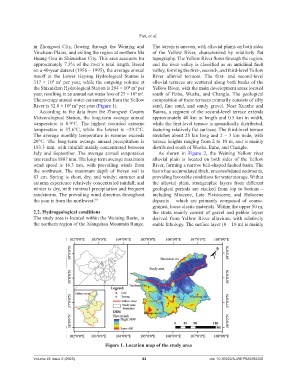
                River is 32.0 × 10  m³ per year (Figure 1).         sand,  fine  sand,  and  sandy  gravel.  Near  Xuanhe  and
                                8
                  According  to the  data  from the  Zhongwei  County   Baima, a segment of the second-level terrace extends
                Meteorological  Station,  the long-term  average  annual   approximately 40 km in length and 0.5 km in width,
                temperature  is 8.9°C.  The highest recorded extreme   while the first-level terrace is sporadically distributed,
                temperature  is  37.6°C,  while  the  lowest  is  −29.2°C.   featuring relatively flat surfaces. The third-level terrace
                The average monthly temperature in summer exceeds   stretches about 25 km long and 2 – 3 km wide, with
                20°C.  The long-term  average  annual  precipitation  is   terrace heights ranging from 2 to 10 m, and is mainly
                183.3 mm, with rainfall mainly concentrated between   distributed south of Wusha, Enhe, and Changle.
                July  and  September.  The  average  annual  evaporation   As  shown  in  Figure  2, the  Weining  Yellow river
                rate reaches 1887 mm. The long-term average maximum   alluvial  plain  is  located  on  both  sides  of  the  Yellow
                wind speed is 16.3  m/s, with prevailing  winds from   River, forming a narrow belt-shaped faulted basin. The
                the northwest.  The maximum depth of frozen soil is   basin has accumulated thick, unconsolidated sediments,
                83  cm. Spring is short, dry, and windy; summer and   providing favorable conditions for water storage. Within
                autumn experience relatively concentrated rainfall; and   the  alluvial  plain,  stratigraphic  layers  from  different
                winter is dry, with minimal precipitation and frequent   geological  periods  are  stacked  from  top  to  bottom  –
                sandstorms. The prevailing wind direction throughout   including  Miocene,  Late  Pleistocene,  and Holocene
                the year is from the northwest. 30                  deposits – which are primarily  composed  of coarse-
                                                                    grained, loose clastic materials. Within the upper 50 m,
                2.2. Hydrogeological conditions                     the  strata  mainly  consist  of  gravel  and  pebble  layers
                The study area is located within the Weining Basin, in   derived  from  Yellow  River  alluvium,  with  relatively
                the northern region of the Xiangshan Mountain Range.   stable lithology. The surface layer (0 – 10 m) is mainly


                                               Figure 1. Location map of the study area


                Volume 22 Issue 5 (2025)                        82                           doi: 10.36922/AJWEP025260208

