


Page 92 - AJWEP-22-5
P. 92
Fan, et al.

                    groundwater  may  indicate ineffective attenuation   Table 1. Constructed judgment matrix for
                    capacity  or  legacy  contamination,  thereby    determining indicator weights
                    undermining  source  suitability  despite  favorable   Analytic   K1  K2  K3  K4  K5  K6  K7  K8
                    hydraulic conditions.                            hierarchy
                (viii)  Groundwater depth (K8): The depth to groundwater   process
                    influences pumping costs, recharge rates, and the   K1      1   1/5  1/4   2   2    1/7  1/4  1/3
                    hydraulic  connection  with  surface  water  bodies.   K2   5    1    3    7   5    1/3  2    3
                    Greater depths increase required pumping lift and   K3      4   1/3   1    5   5    1/3  2    3
                    may  induce  vertical  flow  from  confining  units,
                    potentially  affecting  both  K3  and  the  migration   K4  1/2  1/7  1/5  1   1/3  1/5  1/3  1/2
                    of contaminants. Moreover, as groundwater depth   K5        1/2  1/5  1/5  3   1    1/5  1/4  1/2
                    increases, the influence of river recharge becomes   K6     7    3    3    5   5    1    2    3
                    more attenuated, suggesting a nonlinear and site-  K7       4   1/2  1/3   3   4    1/2  1    2
                    dependent relationship between K8 and both K1    K8         3   1/3  1/3   2   2    1/3  1/2  1
                    and K6 in practical intake performance.          Notes: K1 – K8 represent the following indicators: K1: Minimum
                                                                     river discharge during the dry season ; K2: Riverbed permeability;
                  These interdependencies underscore the importance   K3: Aquifer hydraulic conductivity; K4: Aquifer thickness; K5:
                of a systems-thinking approach in evaluation  model   Presence  of  continuous  impermeable  layers;  K6:  River  water
                construction.  Rather  than treating  each  indicator  as   quality; K7: Groundwater quality; K8: Groundwater depth.
                independent,  this study acknowledges  key functional
                linkages  –  particularly  between  K2  and  K3,  as  well   collectively  determine  the  permissible  groundwater
                as  between  K6  and  K7. Although  this  version  of  the   intake capacity. In addition, K8 primarily affects the cost
                model applies additive weighting through AHP, future   and operational stability of water intake, resulting in a
                enhancements  may incorporate  correlation  analysis,   moderate level of influence. A comprehensive analysis
                interaction terms, or multivariate statistical techniques   of the  importance  of the  eight  evaluation  indicators
                (e.g., principal component analysis or factor analysis)   reveals  the  following  descending  order  of  influence:
                to quantitatively capture  these interrelationships  and   K7 > K8 > K1 > K6 > K2 > K3 > K4 > K5.
                reduce  redundancy.  Such  refinements  would  further
                improve  the internal  consistency and predictive   3.2.2. Calculation of the judgment matrix
                reliability of the suitability assessment framework.  In this  study, a judgment  matrix  constructed  from
                                                                    statistical data is used to quantify the relative importance
                3.2. Determination of evaluation weights            or  influence  of  various  factors.  By  conducting
                3.2.1. Construction of the judgment matrix          pairwise comparisons among the factors and assigning
                Based on the qualitative indicators, one or more river   corresponding values, a positive reciprocal  matrix  is
                sections  are  selected  as potential  groundwater  source   formed.  Subsequently,  the  relative  weight  vector  of
                sites. Subsequently, a weighting analysis was conducted   each factor is obtained through weight calculation and a
                for all the identified quantitative indicators; however, the   consistency check.
                qualitative indicators were excluded from this process.   Based on the  importance  of the  eight  quantitative
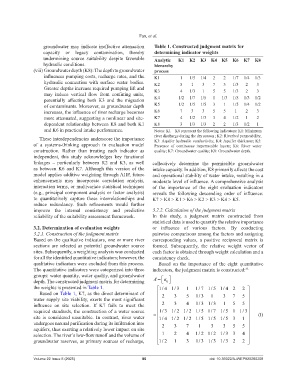
                The quantitative indicators were categorized into three   indicators, the judgment matrix is constructed: 33
                groups: water quantity, water quality, and groundwater
                                                                          ij
                depth. The constructed judgment matrix for determining   A    a
                the weights is presented in Table 1.                   14 13 /    1   1 71 51 42           2
                                                                                                   /
                                                                        /
                                                                                        /
                                                                                              /
                  Based on Table 1, K7, as the direct determinant of
                water supply site viability, exerts the most significant     2  3  5  1 3 /  1    3   7    5
                                                                                         /
                influence  on  site  selection.  If  K7  fails  to  meet  the     2  3  4  13 13 /  1  5   5

                required standards, the construction of a water source    13 12 1/221 51 71 51 13/         /
                                                                              /
                                                                                              /
                                                                                         /
                                                                        /
                site is considered unsuitable. In contrast, river water     14 12 12 15 15 15 3/  /  /  /  /  /  1    (I)
                undergoes natural purification during its infiltration into
                aquifers, thus exerting a relatively lower impact on site     2  3  7  1     3    3   5    5

                                                                                              /
                                                                                                   /
                                                                                        /
                selection. The river’s low-flow runoff and the volume of     1  2  4  1 21 21 33           4
                groundwater reserves, as primary sources of recharge,    1// 2  1  3    / 1 31 31 32       2

                                                                                                   /
                                                                                              /
                Volume 22 Issue 5 (2025)                        86                           doi: 10.36922/AJWEP025260208

