


Page 95 - AJWEP-22-5
P. 95
Evaluation of riverbank water suitability

                and the comprehensive index method was employed to     Based  on  the  established  evaluation  indicator
                assess water quality conditions.                    system, this study assessed eight quantitative indicators.
                  A systematic  analysis  and evaluation  of eight  key   A weighted sum was then calculated using the assigned
                indicators were conducted across the study area to   weights for each indicator. Qualitative indicators – such
                identify optimal zones for riverside water intake. Using   as land use type and safety distance – were integrated in
                the scoring standards for each indicator, ArcGIS was   ArcGIS using a 1:1 weighting ratio. Raster layers were
                employed  to  generate  scoring zonation  maps  for all   multiplied to compute the combined suitability. In the
                quantitative indicators. In terms of spatial analysis, this   resulting output, areas with a value of 0 indicate zones
                study provides a detailed explanation of the interpolation   unsuitable for the construction of riverside water intake
                method (Kriging), grid resolution (50 m × 50 m), and the   sites. Finally, the quantitative and qualitative evaluation
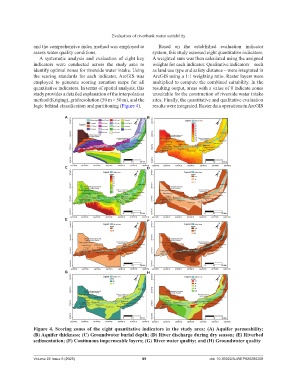
                logic behind classification and partitioning (Figure 4).  results were integrated. Raster data operations in ArcGIS


                              A                                   B


                              C                                   D


                              E                                   F


                              G                                   H


                Figure 4. Scoring zones of the eight quantitative indicators in the study area: (A) Aquifer permeability;
                (B) Aquifer thickness; (C) Groundwater burial depth; (D) River discharge during dry season; (E) Riverbed
                sedimentation; (F) Continuous impermeable layers; (G) River water quality; and (H) Groundwater quality


                Volume 22 Issue 5 (2025)                        89                           doi: 10.36922/AJWEP025260208

