


Page 97 - AJWEP-22-5
P. 97
Evaluation of riverbank water suitability

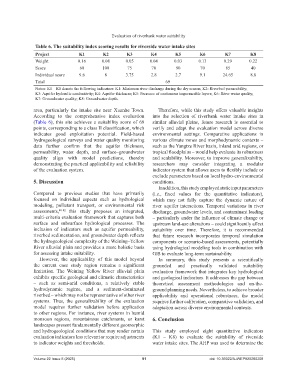
                 Table 6. The suitability index scoring results for riverside water intake sites
                 Project            K1        K2         K3        K4         K5         K6         K7         K8
                 Weight            0.16       0.08      0.05       0.04       0.03      0.13        0.29       0.22
                 Score              60        100        75         70        90         70         85          40
                 Individual score   9.6        8        3.75       2.8        2.7        9.1       24.65       8.8
                 Total                                                    69
                 Notes: K1 – K8 denote the following indicators: K1: Minimum river discharge during the dry season; K2: Riverbed permeability;
                 K3: Aquifer hydraulic conductivity; K4: Aquifer thickness; K5: Presence of continuous impermeable layers; K6: River water quality;
                 K7: Groundwater quality; K8: Groundwater depth.

                area, particularly the intake site near Xuanhe  Town.   Therefore, while this study offers valuable insights
                According to the comprehensive index evaluation     into  the  selection  of  riverbank  water  intake  sites  in
                (Table  6),  this  site  achieves  a  suitability  score  of  69   similar  alluvial  plains, future research  is essential  to
                points, corresponding to a class II classification, which   verify and adapt the evaluation  model across diverse
                indicates  good  exploitation  potential.  Field-based   environmental  settings.  Comparative  applications  in
                hydrogeological surveys and water quality monitoring   various climate zones and morphodynamic contexts –
                data  further  confirm  that  the  aquifer  thickness,   such as the Yangtze River basin, inland arid regions, or
                permeability,  water  depth,  and  surface–groundwater   tropical floodplains – would help evaluate its robustness
                quality  align  with  model  predictions,  thereby   and scalability. Moreover, to improve generalizability,
                demonstrating the practical applicability and reliability   researchers may consider integrating  a modular
                of the evaluation system.                           indicator system that allows users to flexibly include or
                                                                    exclude parameters based on local hydro-environmental
                5. Discussion                                       conditions.
                                                                       In addition, this study employed static input parameters
                Compared  to  previous  studies  that  have  primarily   (i.e.,  fixed  values  for  the  quantitative  indicators),
                focused on individual aspects such as hydrological   which  may  not  fully  capture  the  dynamic  nature  of
                modeling,  pollutant  transport, or environmental  risk   river–aquifer interactions. Temporal variations in river
                assessments, 40-42  this study proposes an integrated,   discharge, groundwater levels, and contaminant loading
                multi-criteria evaluation framework that captures both   – particularly under the influence of climate change or
                surface  and  subsurface  hydrological  processes.  The   upstream land-use alterations – could significantly affect
                inclusion  of  indicators  such  as  aquifer  permeability,   suitability  over  time.  Therefore,  it  is  recommended
                riverbed sedimentation, and groundwater depth reflects   that future research incorporates temporal simulation
                the hydrogeological complexity of the Weining–Yellow   components or scenario-based assessments, potentially
                River alluvial plain and provides a more holistic basis   using hydrological modeling tools in combination with
                for assessing intake suitability.                   GIS to evaluate long-term sustainability.
                  However,  the  applicability  of  this  model  beyond   In  summary,  this  study  presents  a  scientifically
                the  current  case  study  region  remains  a  significant   grounded   and   practically   validated   suitability
                limitation.  The  Weining–Yellow River alluvial  plain   evaluation framework that integrates key hydrological
                exhibits specific geological and climatic characteristics   and geological indicators. It addresses the gap between
                – such  as semi-arid  conditions,  a  relatively  stable   theoretical  assessment methodologies  and on-the-
                hydrodynamic  regime,  and a sediment-dominated     ground planning needs. Nevertheless, to achieve broader
                riverbed – which may not be representative of other river   applicability  and  operational  robustness,  the  model
                systems.  Thus,  the  generalizability  of  the  evaluation   requires further calibration, comparative validation, and
                model  requires  further  validation  before  application   adaptation across diverse environmental contexts.
                to other regions. For instance, river systems in humid
                monsoon regions, mountainous catchments,  or karst   6. Conclusion
                landscapes present fundamentally different geomorphic
                and hydrogeological conditions that may render certain   This study employed  eight  quantitative  indicators
                evaluation indicators less relevant or require adjustments   (K1  –  K8)  to  evaluate  the  suitability  of  riverside
                to indicator weights and thresholds.                water intake sites. The AHP was used to determine the


                Volume 22 Issue 5 (2025)                        91                           doi: 10.36922/AJWEP025260208

