


Page 96 - AJWEP-22-5
P. 96
Fan, et al.

                were  used  to  generate  the  comprehensive  suitability   Hydrogeologically, the aquifer in this region consists
                map, which was then classified into zones according to   of alluvial  sand and  gravel  with  diverse  lithological
                the integrated scoring classification standard. The final   compositions and interbedded low-permeability layers,
                suitability  zoning  of  water  source  intake  sites  in  the   such  as  fine  sand  and  silt.  The  average  permeability
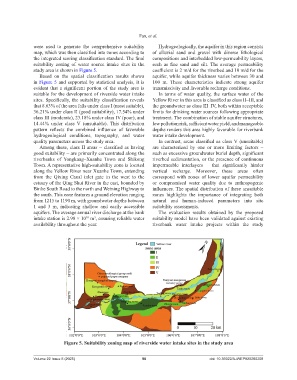
                study area is shown in Figure 5.                    coefficient is 2 m/d for the riverbed and 10 m/d for the
                  Based  on  the  spatial  classification  results  shown   aquifer, while aquifer thickness varies between 30 and
                in Figure 5 and supported by statistical analysis, it is   100  m.  These characteristics  indicate  strong aquifer
                evident  that  a  significant  portion  of  the  study  area  is   transmissivity and favorable recharge conditions.
                suitable for the development of riverside water intake   In terms of water quality, the surface water of the
                sites. Specifically, the suitability classification reveals   Yellow River in this area is classified as class II–III, and
                that 8.63% of the area falls under class I (most suitable),   the groundwater as class III–IV, both within acceptable
                36.21% under class II (good suitability), 17.54% under   limits for drinking water sources following appropriate
                class III (moderate), 23.18% under class IV (poor), and   treatment. The combination of stable aquifer structures,
                14.44%  under  class  V  (unsuitable).  This  distribution   low pollution risk, sufficient water yield, and manageable
                pattern  reflects  the  combined  influence  of  favorable   depths renders this area highly favorable for riverbank
                hydrogeological  conditions,  topography, and water   water intake development.
                quality parameters across the study area.              In contrast, areas classified as class V (unsuitable)
                  Among  these,  class  II  areas  –  classified  as  having   are  characterized  by  one  or  more  limiting  factors  –
                good suitability – are primarily concentrated along the   such as excessive groundwater burial depth, significant
                riverbanks  of  Yongkang–Xuanhe  Town  and  Shikong   riverbed sedimentation, or the presence of continuous
                Town. A representative high-suitability zone is located   impermeable  interlayers  –  that  significantly  hinder
                along the Yellow River near Xuanhe Town, extending   vertical  recharge.  Moreover, these  areas  often
                from the Qixing Canal  inlet gate  in the west to the   correspond  with  zones  of  lower  aquifer  permeability
                estuary of the Qing Shui River in the east, bounded by   or compromised water quality due to anthropogenic
                Binhe South Road to the north and Weining Highway to   influences. The spatial distribution of these unsuitable
                the south. This zone features a ground elevation ranging   zones  highlights  the  importance  of  integrating  both
                from 1215 to 1190 m, with groundwater depths between   natural  and human-induced  parameters  into site
                1  and  3  m,  indicating  shallow  and  easily  accessible   suitability assessments.
                aquifers. The average annual river discharge at the bank   The  evaluation  results  obtained  by  the  proposed
                intake station is 2.98 × 10  m , ensuring reliable water   suitability model have been validated against existing
                                          3
                                       10
                availability throughout the year.                   riverbank  water  intake  projects  within  the  study


                             Figure 5. Suitability zoning map of riverside water intake sites in the study area


                Volume 22 Issue 5 (2025)                        90                           doi: 10.36922/AJWEP025260208

