


Page 89 - AJWEP-22-5
P. 89
Evaluation of riverbank water suitability


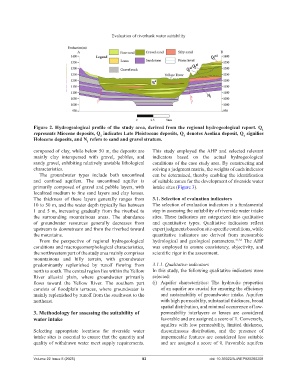
                Figure 2. Hydrogeological profile of the study area, derived from the regional hydrogeological report. Q
                                                                                                                    1
                represents Miocene deposits, Q  indicates Late Pleistocene deposits, Q  denotes Aeolian deposit, Q  signifies
                                             2
                Holocene deposits, and N  refers to sand and gravel stratum.      3                         4
                                       1
                composed of clay, while below 50 m, the deposits are   This study employed the  AHP and selected  relevant
                mainly  clay  interspersed  with  gravel,  pebbles,  and   indicators  based  on  the  actual  hydrogeological
                sandy gravel, exhibiting relatively unstable lithological   conditions of the case study area. By constructing and
                characteristics.                                    solving a judgment matrix, the weights of each indicator
                  The  groundwater  types  include  both  unconfined   can be determined, thereby enabling the identification
                and  confined  aquifers.  The  unconfined  aquifer  is   of suitable zones for the development of riverside water
                primarily composed of gravel and pebble layers, with   intake sites (Figure 3).
                localized medium to fine sand layers and clay lenses.
                The thickness of these  layers generally  ranges from   3.1. Selection of evaluation indicators
                10 to 50 m, and the water depth typically lies between   The selection of evaluation indicators is a fundamental
                1 and 5 m, increasing gradually from the riverbed to   step in assessing the suitability of riverside water intake
                the  surrounding  mountainous  areas.  The  abundance   sites. These indicators are categorized into qualitative
                of groundwater resources generally  decreases  from   and  quantitative  types.  Qualitative  indicators  reflect
                upstream to downstream and from the riverbed toward   expert judgments based on site-specific conditions, while
                the mountains.                                      quantitative  indicators  are  derived  from  measurable
                  From the perspective  of regional  hydrogeological   hydrological  and geological  parameters. 31,32   The AHP
                conditions and macrogeomorphological characteristics,   was  employed  to  ensure  consistency,  objectivity,  and
                the northwestern part of the study area mainly comprises   scientific rigor in the assessment.
                mountainous and hilly terrain, with groundwater
                predominantly  replenished  by  runoff  flowing  from   3.1.1. Qualitative indicators
                north to south. The central region lies within the Yellow   In this study, the following qualitative indicators were
                River  alluvial plain,  where  groundwater  primarily   selected:
                flows  toward  the  Yellow  River.  The  southern  part   (i)  Aquifer characteristics:  The hydraulic  properties
                consists  of  floodplain  terraces,  where  groundwater  is   of an aquifer are crucial for ensuring the efficiency
                mainly replenished by runoff from the southwest to the   and sustainability of groundwater intake. Aquifers
                northeast.                                              with high permeability, substantial thickness, broad
                                                                        spatial distribution, and minimal occurrence of low-
                3. Methodology for assessing the suitability of         permeability  interlayers  or  lenses  are  considered
                water intake                                            favorable and are assigned a score of 1. Conversely,
                                                                        aquifers with low permeability, limited thickness,
                Selecting  appropriate  locations  for riverside water   discontinuous  distribution,  and  the  presence  of
                intake sites is essential to ensure that the quantity and   impermeable features are considered less suitable
                quality of withdrawn water meet supply requirements.    and are assigned a score of 0. Favorable aquifers


                Volume 22 Issue 5 (2025)                        83                           doi: 10.36922/AJWEP025260208

