


Page 10 - AJWEP-22-6
P. 10
Syromiatnykov

                the  2   year.  In  addition,  introduced  strains  were  still   Latvia also demonstrated that inoculation with diverse
                    nd
                detectable in the soil, suggesting long-term ecological   microbial  consortia—including  St,  Paraburkholderia,
                integration. 41                                     and Ps—increased nodule-associated bacterial diversity
                  In the context of conservation agriculture and organic   and  plant  growth-promoting  traits,  further  confirming
                farming, inoculation-induced BNF contributes to long-  the  synergistic  effects  of  integrating  nitrogen-fixing
                term soil fertility by increasing organic matter content   bacteria  with  humic  substances  under  real-world
                and  enhancing  nitrogen  cycling—key  components  of   conditions. 48
                sustainable land management. 42-47                     Table 1 presents a comparative overview of nitrogen-
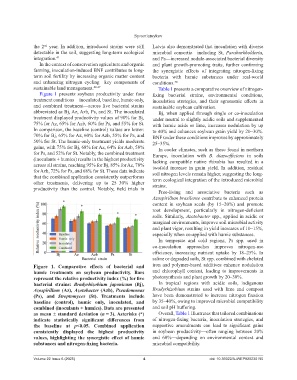
                  Figure  1 presents soybean  productivity  under  four   fixing  bacterial  strains,  environmental  conditions,
                treatment conditions—inoculated, baseline, humic only,   inoculation  strategies,  and  their  agronomic  effects  in
                and combined treatment—across five bacterial strains   sustainable soybean cultivation.
                abbreviated as Bj, Az, Azb, Ps, and St. The inoculated   Bj,  when  applied  through  single  or  co-inoculation
                treatment displayed productivity values of 90% for Bj,   under neutral to slightly acidic soils and supplemented
                75% for Az, 65% for Azb, 60% for Ps, and 55% for St.   with humic acids or lime, increases nodulation by up
                In comparison, the baseline (control) values are lower:   to 40% and enhances soybean grain yield by 20–30%.
                70% for Bj, 65% for Az, 60% for Azb, 55% for Ps, and   BNF under these conditions improves by approximately
                50% for St. The humic-only treatment yields moderate   25–35%.
                gains, with 75% for Bj, 68% for Az, 64% for Azb, 58%   In cooler climates, such as those found in northern
                for Ps, and 52% for St. Notably, the combined treatment   Europe,  inoculation  with  B.  diazoefficiens in  soils
                (inoculants + humics) results in the highest productivity   lacking  compatible  native  rhizobia  has  resulted  in  a
                across all strains, reaching 95% for Bj, 85% for Az, 78%   twofold  increase  in  grain  yield.  In  addition,  residual
                for Azb, 72% for Ps, and 68% for St. These data indicate   soil nitrogen levels remain higher, suggesting the long-
                that the combined application consistently outperforms
                other  treatments,  delivering  up  to  25–30%  higher   term ecological integration of the introduced microbial
                productivity  than  the  control.  Notably,  field  trials  in   strains.
                                                                       Free-living  and associative  bacteria  such as
                                                                    Azospirillum brasilense contribute to enhanced protein
                                                                    content  in  soybean  seeds  (by  15–20%)  and  promote
                                                                    root  development,  particularly  in  nitrogen-deficient
                                                                    soils. Similarly, Azotobacter spp., applied in acidic or
                                                                    marginal environments, improve soil microbial activity
                                                                    and plant vigor, resulting in yield increases of 10–15%,
                                                                    especially when co-applied with humic substances.
                                                                       In temperate  and cold regions, Ps  spp.  used in
                                                                    co-inoculation  approaches improves nitrogen-use
                                                                    efficiency,  increasing  nutrient  uptake  by  18–25%.  In
                                                                    saline or degraded soils, St spp. combined with chelated
                Figure  1.  Comparative  effects  of  bacterial  and   iron and polymer-based additives enhance  nodulation
                humic treatments on  soybean  productivity. Bars    and  chlorophyll  content,  leading  to  improvements  in
                represent the relative productivity index (%) for five   photosynthesis and plant growth by 20–30%.
                bacterial  strains:  Bradyrhizobium japonicum  (Bj),   In  tropical  regions  with  acidic  soils,  indigenous
                Azospirillum (Az), Azotobacter (Azb), Pseudomonas   Bradyrhizobium  strains  used  with  lime  and  compost
                (Ps),  and  Streptomyces  (St).  Treatments  include   have  been  demonstrated  to  increase  nitrogen  fixation
                baseline  (control),  humic  only,  inoculated,  and   by 35–40%, owing to improved microbial compatibility
                combined (inoculants + humics). Data are presented   and soil pH buffering.
                as mean ± standard deviation (n = 3). Asterisks (*)    Overall, Table 1 illustrates that tailored combinations
                indicate  statistically  significant  differences  from   of nitrogen-fixing bacteria, inoculation strategies, and
                the baseline at  p<0.05. Combined  application      supportive  amendments  can  lead  to  significant  gains
                consistently displayed the highest productivity     in soybean productivity—often ranging between 20%
                values,  highlighting  the  synergistic  effect  of  humic   and  60%—depending  on  environmental  context  and
                substances and nitrogen-fixing bacteria.            microbial compatibility.


                Volume 22 Issue 6 (2025)                        4                            doi: 10.36922/AJWEP025230190

