


Page 11 - AJWEP-22-6
P. 11
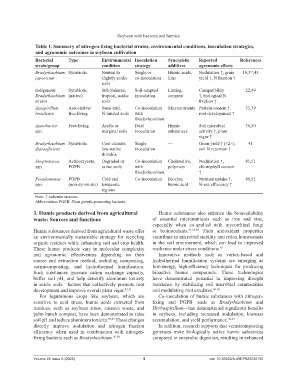
Soybean with bacteria and humics

                 Table 1. Summary of nitrogen-fixing bacterial strains, environmental conditions, inoculation strategies,
                 and agronomic outcomes in soybean cultivation

                 Bacterial     Type           Environmental  Inoculation   Synergistic   Reported          References
                 strain/group                 condition     strategy       additives     agronomic effects
                 Bradyrhizobium  Symbiotic    Neutral to    Single or      Humic acids,   Nodulation ↑, grain   10,37,45
                 japonicum                    slightly acidic   co-inoculation  lime     yield ↑, N fixation ↑
                                              soils
                 Indigenous    Symbiotic      Sub-Saharan,   Soil-adapted   Liming,      Compatibility       22,49
                 Bradyrhizobium  (native)     tropical, acidic   inoculation  compost    ↑, biological N
                 strains                      soils                                      fixation ↑
                 Azospirillum   Associative/  Semi-arid,    Co-inoculation   Micronutrients Protein content ↑,   35,39
                 brasilense    free-living    N-limited soils  with                      root development ↑
                                                            Bradyrhizobium
                 Azotobacter   Free-living    Acidic or     Dual           Humic         Soil microbial      36,50
                 spp.                         marginal soils  inoculation  substances    activity ↑, plant
                                                                                         vigor ↑
                 Bradyrhizobium  Symbiotic    Cool-climate,   Single       —             Grain yield ↑ (≈2×),   41
                 diazoefficiens               low-native    inoculation                  soil N retention ↑
                                              rhizobia
                 Streptomyces   Actinomycete,   Degraded or   Co-inoculation   Chelated Fe,   Nodulation ↑,   45,51
                 spp.          PGPB           saline soils  with           polymers      chlorophyll content
                                                            Bradyrhizobium               ↑
                 Pseudomonas   PGPB           Cold and      Co-inoculation  Biochar,     Nutrient uptake ↑,   46,51
                 spp.          (non-symbiotic) temperate                   humic acid    N-use efficiency ↑
                                              regions
                 Note: ↑ indicates increase.
                 Abbreviation: PGPB: Plant growth-promoting bacteria.

                3. Humic products derived from agricultural            Humic  substances  also  enhance  the  bioavailability
                waste: Sources and functions                        of  essential  micronutrients  such  as  iron  and  zinc,
                                                                    especially  when  co-applied  with  mycorrhizal  fungi
                Humic substances derived from agricultural waste offer   or bioinoculants. 31,55,58   Their  antioxidant  properties
                an  environmentally  sustainable  strategy  for recycling   contribute to microbial stability and redox homeostasis
                organic residues while enhancing soil and crop health.   in  the  soil  environment,  which  can  lead  to  improved
                These  humic  products  vary  in  molecular  complexity   resilience under stress conditions. 59
                and  agronomic  effectiveness  depending  on  their    Innovative  methods  such  as  vortex-based  and
                source  and  extraction  method,  including  composting,   hydrothermal  humification  systems  are  emerging  as
                vermicomposting,  and  hydrothermal  humification.   low-energy,  high-efficiency  techniques  for  producing
                Such  substances  increase  cation  exchange  capacity,   bioactive  humic compounds.  These technologies
                buffer  soil  pH,  and  help  detoxify  aluminum  toxicity   have demonstrated potential in improving drought
                in acidic soils—factors that collectively promote root   resistance  by  stabilizing  soil  microbial  communities
                development and improve overall plant vigor. 52,53  and modulating root exudates. 60-62
                  For  leguminous  crops  like  soybean,  which  are   Co-inoculation of humic substances with nitrogen-
                sensitive  to  acid  stress,  humic  acids  extracted  from   fixing  and  PGPB—such  as  Bradyrhizobium and
                residues,  such  as  soybean  straw,  cassava  waste,  and   Herbaspirillum—has demonstrated significant benefits
                palm bunch compost, have been demonstrated to raise   in  soybean,  including  increased  nodulation,  biomass
                soil pH and reduce aluminum toxicity. 54,55  These changes   accumulation, and yield performance. 32,63
                directly  improve  nodulation  and  nitrogen  fixation   In addition, research supports that vermicomposting
                efficiency  when  used  in  combination  with  nitrogen-  generates  more biologically  active  humic substances
                fixing bacteria such as Bradyrhizobium. 56-58       compared to anaerobic digestion, resulting in enhanced


                Volume 22 Issue 6 (2025)                        5                            doi: 10.36922/AJWEP025230190

