


Page 14 - AJWEP-22-6
P. 14
Syromiatnykov

                increased  auxin-like  activity  and  antioxidant  enzyme   in  enhancing  BNF  and  productivity  when  combined
                responses in co-treated soybean plants, contributing to   with  inoculants.  These  results  highlight  the  superior
                higher photosynthetic rates and yield components. 70,71  performance  of  Bj  and Az  under  co-application  with
                  In  acidic  soils  where  aluminum  toxicity  restricts   humic substances, supporting their role in enhancing
                nodulation,  humic  substances  chelate  toxic  ions  and   nitrogen fixation and plant growth efficiency.
                buffer  pH,  enabling  better  survival  and  effectiveness   Table 3 summarizes the synergistic effects observed
                of acid-tolerant Bradyrhizobium strains. These actions   when humic substances are co-applied with nitrogen-
                restore  the  root  zone  microenvironment and  facilitate   fixing  bacteria  under  different  stress  conditions  in
                robust symbiosis even in marginal lands. 72-74      soybean cultivation. For example, applying humic acid
                  Furthermore, the co-inoculation  approach reduces   with Bj in acidic soils (pH < 5.5) increased nodulation
                reliance  on  synthetic  fertilizers  by  boosting  internal   by 30–40% and yield by 20–25%. 49,72,74  Under drought
                nitrogen  supply  through  improved  BNF.  In  multiple   stress,  fulvic  acid  combined  with  A.  brasilense
                field  trials,  humic-enhanced  inoculants  have  led  to   enhanced root biomass by 25%, photosynthetic rate by
                increased grain yield, seed protein content, and residual   15%, and grain yield significantly. 50,70,71 . In compacted
                soil  nitrogen—benefits  that  extend  into  subsequent   or  oxygen-poor  soils,  humin  with  Bradyrhizobium
                cropping cycles. 75                                 and  Herbaspirillum improved  nitrogenase  activity
                  Precision delivery systems, such as humic-coated   by 35% and raised seed protein content. 28,72  A mix of
                granules and encapsulated inoculants, offer additional   humic  and  fulvic  acids  with  St  and  B. japonicum in
                advantages  by protecting  microbial  viability  during   saline  soils  improved  germination  by  20%  and  shoot
                storage  and  application.  These  controlled-release   nitrogen concentration. 48,51   Artificial  humic  acids
                formulations  ensure  better  synchronization  between   with  Bradyrhizobium-Ps consortia  under  semi-arid
                microbial activity and plant demand. 76             conditions  increased  grain  yield  by  30–40%  and  left
                  Together,  humic  products  and  nitrogen-fixing   more residual nitrogen in the soil. 65,66  The use of humic-
                bacteria  represent  a potent  agroecological  input  pair   coated inoculants improved microbial  survival and
                that enhances productivity, promotes resilience,  and   long-term  BNF,  boosting  crop  resilience  in  organic
                contributes to long-term soil health, making them vital   systems. 35,75,77   Finally,  vermicompost-derived  humates
                tools in climate-smart and organic farming systems.  applied  with  mixed  PGPR  enhanced  biomass  by
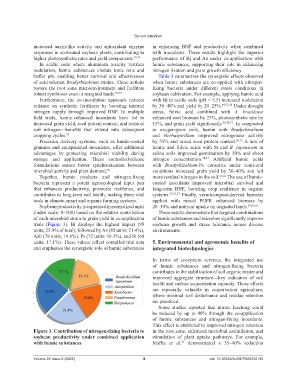
                  Soybean productivity is expressed in normalized units   20–30% and nutrient uptake on degraded lands. 59,61,62
                (index scale: 0–100) based on the relative contribution   These results demonstrate that targeted combinations
                of each microbial strain to grain yield in co-application   of humic substances and microbes significantly improve
                trials  (Figure  3).  Bj  displays  the  highest  impact  (95   soybean  growth  and  stress  tolerance  across  diverse
                units; 23.9% of total), followed by Az (85 units; 21.4%),   environments.
                Azb (78 units; 19.6%), Ps (72 units; 18.1%), and St (68
                units; 17.1%). These values reflect compiled trial data   5. Environmental and agronomic benefits of
                and emphasize the synergistic role of humic substances   integrated biotechnologies

                                                                    In terms of ecosystem  services, the  integrated  use
                                                                    of  humic  substances  and  nitrogen-fixing  bacteria
                                                                    contributes to the stabilization of soil organic matter and
                                                                    improved  aggregate  structure—key  indicators  of  soil
                                                                    health and carbon sequestration capacity. These effects
                                                                    are especially valuable in conservation agriculture,
                                                                    where  minimal  soil  disturbance  and  residue  retention
                                                                    are practiced.
                                                                       Some studies reported  that  nitrate  leaching  could
                                                                    be  reduced  by  up  to  40%  through  the  co-application
                                                                    of  humic  substances  and  nitrogen-fixing  inoculants.
                                                                    This effect is attributed to improved nitrogen retention
                Figure 3. Contribution of nitrogen-fixing bacteria to   in the root zone, enhanced microbial assimilation, and
                soybean productivity  under  combined  application   stimulation  of  plant  uptake  pathways.  For  example,
                with humic substances                               Maffia  et al.   demonstrated  a  35–40%  reduction
                                                                                 31


                Volume 22 Issue 6 (2025)                        8                            doi: 10.36922/AJWEP025230190

