


Page 16 - AJWEP-22-6
P. 16
Syromiatnykov

                soybean (Glycine max) plants, particularly under abiotic   inoculants  supports multiple  sustainability  goals
                stresses, such as drought, salinity, or degraded  soils.   simultaneously, making this biotechnology  approach
                For  example,  humic-acid-enriched  inoculants  have   highly  valuable  in  climate-smart  and  regenerative
                improved shoot nitrogen levels and chlorophyll content   agriculture systems.
                in  soybeans  grown  under  water  stress,  outperforming   Table 4 outlines the key environmental and agronomic
                conventional inputs. 80-82                          benefits of combining humic substances with nitrogen-
                  Furthermore,  nutrient  use  efficiency—particularly   fixing bacteria in soybean systems.
                for nitrogen and iron—is improved due to the chelating   This integration improves soil health, increasing soil
                properties of humic substances and their influence on   organic carbon by 15–20% through better humification
                root  architecture.  These  traits  expand  the  absorptive   and aggregation processes. 31,77  Nutrient use efficiency,
                surface area and enhance mineral uptake. 83         particularly for nitrogen and iron, rises by 25–35% and
                  From  a  policy  and  certification  standpoint,   20%, respectively, due to enhanced chelation and root
                these  biotechnologies  align  with  organic  farming   development. 65,83
                standards  and  are  increasingly  recognized  under   Regarding  nitrogen  loss reduction,  the  use  of
                eco-labeling  frameworks,  facilitating  their  adoption   microbial inoculants with humics cuts nitrate leaching
                in environmentally  sensitive areas.  As  such, their   and  ammonia  volatilization  by  up  to  40%,  helping
                relevance extends beyond conventional agriculture and   protect  water  and  air  quality. 78,79  Under abiotic  stress
                into regenerative and organic markets, where synthetic   conditions, such as drought or salinity, co-application
                inputs are minimized. 84                            boosts  yield  by  25–30%  and  increases  chlorophyll
                  Finally, by converting agro-industrial and municipal   content, improving photosynthesis and resilience. 69,80,82
                organic waste into humic biofertilizers, this approach   This approach also enhances soil microbiota, increasing
                contributes  to  circular  economy  goals—transforming   rhizosphere  biodiversity  and  sustaining  beneficial
                waste liabilities into agronomic assets. 85         bacterial populations across seasons. 32,42
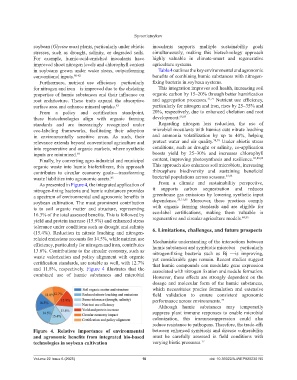
                  As presented in Figure 4, the integrated application of   From a climate and sustainability  perspective,
                nitrogen-fixing bacteria and humic substances provides   it  supports  carbon  sequestration  and  reduces
                a spectrum of environmental and agronomic benefits in   greenhouse gas emissions by lowering synthetic input
                soybean cultivation. The most prominent contribution   dependence. 25,31,85   Moreover,  these  practices  comply
                is to soil organic  matter  and structure,  representing   with  organic  farming  standards  and  are  eligible  for
                16.3% of the total assessed benefits. This is followed by   eco-label  certifications,  making  them  valuable  in
                yield and protein increase (15.9%) and enhanced stress   regenerative and circular agriculture models. 84,85
                tolerance under conditions such as drought and salinity   6. Limitations, challenges, and future prospects
                (15.4%).  Reduction  in  nitrate  leaching  and  nitrogen-
                related emissions accounts for 14.5%, while nutrient use   Mechanistic understanding of the interactions between
                efficiency, particularly for nitrogen and iron, contributes   humic substances and symbiotic microbes—particularly
                13.6%. Contributions to the circular economy, such as   nitrogen-fixing  bacteria  such  as  Bj  —is  improving,
                waste  valorization  and  policy  alignment  with  organic   yet  considerable  gaps remain.  Recent  studies suggest
                certification standards, are notable as well, with 12.7%   that humic compounds can modulate gene expression
                and  11.8%,  respectively.  Figure  4 illustrates that the   associated with nitrogen fixation and nodule formation.
                combined use of humic substances and microbial      However,  these  effects  are  strongly  dependent  on  the

                                                                    dosage and molecular  form of the humic substances,
                                                                    which  necessitates  precise  formulation  and  extensive
                                                                    field  validation  to  ensure  consistent  agronomic
                                                                    performance across environments. 77
                                                                       Although humic  substances may temporarily
                                                                    suppress plant immune responses to enable microbial
                                                                    colonization,  this  immunosuppression  could  also
                                                                    reduce resistance to pathogens. Therefore, the trade-offs
                Figure  4. Relative  importance  of environmental   between enhanced symbiosis and disease vulnerability
                and  agronomic  benefits  from  integrated  bio-based   must  be  carefully  assessed  in  field  conditions  with
                technologies in soybean cultivation                 varying biotic pressures. 77


                Volume 22 Issue 6 (2025)                        10                           doi: 10.36922/AJWEP025230190

