


Page 13 - AJWEP-22-6
P. 13
Soybean with bacteria and humics

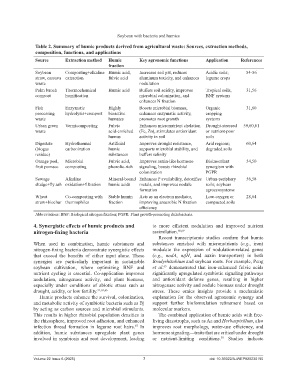
                 Table 2. Summary of humic products derived from agricultural waste: Sources, extraction methods,
                 composition, functions, and applications

                 Source       Extraction method  Humic        Key agronomic functions       Application    References
                                                 fraction
                 Soybean      Composting+alkaline  Humic acid,   Increases soil pH, reduces   Acidic soils;   54-56
                 straw, cassava  extraction      fulvic acid  aluminum toxicity, and enhances   legume crops
                 waste                                        nodulation
                 Palm bunch   Thermochemical     Humic acid   Buffers soil acidity, improves   Tropical soils,   31,56
                 compost      humification                    microbial colonization, and   BNF systems
                                                              enhances N fixation
                 Fish         Enzymatic          Highly       Boosts microbial biomass,     Organic          31,60
                 processing   hydrolysis+compost  bioactive   enhances enzymatic activity,   cropping
                 waste                           humates      promotes root growth          systems
                 Urban green   Vermicomposting   Fulvic       Enhances micronutrient chelation  Drought-stressed   59,60,61
                 waste                           acid-enriched   (Fe, Zn), stimulates antioxidant   or nutrient-poor
                                                 humus        activity in soil              soils
                 Digestate    Hydrothermal       Artificial   Improves drought resistance,   Arid regions;   60,64
                 (biogas      carbonization      humic        supports microbial stability, and   degraded soils
                 residue)                        substances   buffers salinity
                 Orange peel,   Microbial        Fulvic acid,   Improves auxin-like hormone   Bioinoculant   54,50
                 fruit pomace  composting        phenolic-rich  signaling, boosts rhizobial   synergism with
                                                              colonization                  PGPR
                 Sewage       Alkaline           Mineral-bound  Enhances P availability, detoxifies  Urban-periphery   56,58
                 sludge+fly ash oxidation+filtration  humic acids  metals, and improves nodule   soils; soybean
                                                              formation                     agroecosystems
                 Wheat        Co-composting with   Stable humin   Acts as an electron mediator,   Low-oxygen or   28,64
                 straw+biochar thermophiles      fraction     improving anaerobic N fixation   compacted soils
                                                              efficiency
                 Abbreviations: BNF: Biological nitrogen fixation; PGPR: Plant growth-promoting rhizobacteria.

                4. Synergistic effects of humic products and        to  more  efficient  nodulation  and  improved  nutrient
                nitrogen-fixing bacteria                            assimilation. 68,69
                                                                       Recent  transcriptomic  studies  confirm  that  humic
                When used in combination,  humic substances and     substances  enriched  with  micronutrients  (e.g., iron)
                nitrogen-fixing bacteria demonstrate synergistic effects   modulate  the  expression  of  nodulation-related  genes
                that  exceed  the  benefits  of  either  input  alone.  These   (e.g.,  nodA,  nifH,  and  auxin  transporters)  in  both
                synergies  are  particularly  important  in  sustainable   Bradyrhizobium and soybean roots. For example, Peng
                soybean  cultivation,  where  optimizing  BNF  and   et al.  demonstrated  that iron-enhanced  fulvic acids
                                                                         65
                nutrient  cycling  is  essential.  Co-application  improves   significantly upregulated symbiotic signaling pathways
                nodulation,  nitrogenase  activity, and plant  biomass,   and  antioxidant  defense  genes,  resulting  in  higher
                especially  under  conditions  of abiotic  stress such as   nitrogenase activity and nodule biomass under drought
                drought, acidity, or low fertility. 51,65,66        stress.  These omics insights provide a mechanistic
                  Humic products enhance the survival, colonization,   explanation  for  the  observed  agronomic  synergy  and
                and metabolic activity of symbiotic bacteria such as Bj   support  further  bioformulation  refinement  based  on
                by acting as carbon sources and microbial stimulants.   molecular markers.
                This results in higher rhizobial population densities in   The combined application of humic acids with free-
                the rhizosphere, improved root adhesion, and enhanced   living diazotrophs, such as Az and Herbaspirillum, also
                infection  thread formation  in legume  root hairs.  In   improves  root  morphology,  water-use  efficiency,  and
                                                            67
                addition,  humic substances upregulate  plant genes   hormone signaling—traits that are critical under drought
                involved in symbiosis and root development,  leading   or  nutrient-limiting  conditions.   Studies  indicate
                                                                                                  50


                Volume 22 Issue 6 (2025)                        7                            doi: 10.36922/AJWEP025230190

