


Page 21 - AJWEP-22-6
P. 21
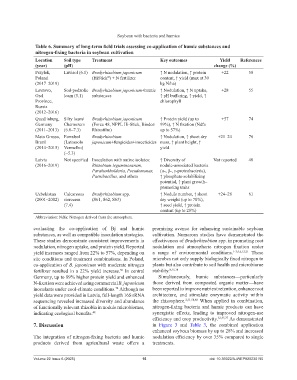
Soybean with bacteria and humics

                 Table 6. Summary of long-term field trials assessing co-application of humic substances and
                 nitrogen-fixing bacteria in soybean cultivation

                 Location    Soil type    Treatment                     Key outcomes              Yield    References
                 (year)      (pH)                                                              change (%)
                 Przylek,    Luvisol (6.1) Bradyrhizobium japonicum     ↑ N nodulation, ↑ protein   +22        50
                 Poland                   (HiStick ) + N fertilizer     content, ↑ yield (max at 30
                                                ®
                 (2017–2019)                                            kg N/ha)
                 Lavrovo,    Sod-podzolic  Bradyrhizobium japonicum+humic  ↑ Nodulation, ↑ N uptake,   +28     55
                 Orel        loam (5.1)   substances                    ↑ pH buffering, ↑ yield, ↑
                 Province,                                              chlorophyll
                 Russia
                 (2012–2016)
                 Quedlinburg,  Silty loam/  Bradyrhizobium japonicum    ↑ Protein yield (up to     +57         74
                 Germany     Chernozem    (Force 48, NPPL Hi-Stick, Biodoz  99%), ↑ N fixation (Ndfa
                 (2011–2013)  (6.8–7.3)   Rhizofilm)                    up to 57%)
                 Mato Grosso,  Ferralsol   Bradyrhizobium               ↑ Nodulation, ↑ shoot dry   +21–24     76
                 Brazil      (Latossolo   japonicum+fungicides+insecticides mass, ↑ plant height, ↑
                 (2014–2015)  Vermelho)                                 yield
                             (~5.3)
                 Latvia      Not specified Inoculation with native isolates:   ↑ Diversity of   Not reported   48
                 (2016–2019)              Rhizobium leguminosarum,      nodule-associated bacteria
                                          Paraburkholderia, Pseudomonas,   (α-, β-, γ-proteobacteria),
                                          Paenibacillus, and others     ↑ phosphate-solubilizing
                                                                        potential, ↑ plant growth–
                                                                        promoting traits
                 Uzbekistan   Calcareous   Bradyrhizobium spp.          ↑ Nodule number, ↑ shoot   +24–28      61
                 (2001–2002)  sierozem    (S61, S62, S63)               dry weight (up to 70%),
                             (7.4)                                      ↑ seed yield, ↑ protein
                                                                        content (up to 28%)
                 Abbreviation: Ndfa: Nitrogen derived from the atmosphere.

                evaluating  the  co-application  of  Bj  and  humic   promising  avenue  for enhancing  sustainable  soybean
                substances, as well as compatible inoculation strategies.   cultivation.  Numerous  studies have  demonstrated  the
                These studies demonstrate consistent improvements in   effectiveness of Bradyrhizobium spp. in promoting root
                nodulation, nitrogen uptake, and protein yield. Reported   nodulation  and  atmospheric  nitrogen  fixation  under
                yield increases ranged from 22% to 57%, depending on   a range of environmental  conditions. 1-3,5,6,12,21  These
                site conditions and treatment combinations. In Poland,   microbes not only supply biologically fixed nitrogen to
                co-application of B. japonicum with moderate nitrogen   plants but also contribute to soil health and microbiome
                fertilizer resulted in a 22% yield increase.  In central   stability. 8,15,18
                                                      50
                Germany, up to 99% higher protein yield and enhanced   Simultaneously,  humic  substances—particularly
                N-fixation were achieved using commercial B. japonicum   those  derived  from  composted  organic  matter—have
                inoculants under cool-climate conditions.  Although no   been reported to improve nutrient retention, enhance root
                                                    74
                yield data were provided in Latvia, full-length 16S rRNA   architecture,  and  stimulate  enzymatic  activity  within
                sequencing revealed increased diversity and abundance   the  rhizosphere. 2,31,58,60   When applied in combination,
                of functionally relevant rhizobia in nodule microbiomes,   nitrogen-fixing bacteria and humic products can have
                indicating ecological benefits. 48                  synergistic  effects,  leading  to  improved  nitrogen-use
                                                                    efficiency and crop productivity. 32,35,77  As demonstrated
                7. Discussion                                       in  Figure  3  and  Table  3,  the  combined  application
                                                                    enhanced soybean biomass by up to 28% and increased
                The integration of nitrogen-fixing bacteria and humic   nodulation efficiency by over 35% compared to single
                products  derived  from  agricultural  waste  offers  a   treatments.


                Volume 22 Issue 6 (2025)                        15                           doi: 10.36922/AJWEP025230190

