


Page 19 - AJWEP-22-6
P. 19
Soybean with bacteria and humics

                or chemical fertilizer controls, particularly when humic   impact  score  (scale:  1–5)  was  assigned  to  each  entry
                formulations lacked consistent molecular composition   based on the strength of reported physiological effects,
                or  when  application  timing  was  suboptimal.  These   agronomic benefits, and frequency of field validation.
                                                         89
                findings underscore the need for careful strain-genotype   One major issue is formulation variability—humic
                matching, robust quality control of humic products, and   substances  derived  from  different  organic  wastes  and
                site-specific management practices.                 extraction  methods  often  exhibit  inconsistent  field
                  By acknowledging these non-significant outcomes,   results. This lack of standardization limits reproducibility
                future research can better  identify  the boundary   and regulatory acceptance. 60,64   Future  efforts  should
                conditions under which co-application is most effective,   focus on classifying humic products based on molecular
                rather than assuming universal success across contexts.  properties and developing universal quality standards.
                  Despite  these  limitations,  the  potential  of  humic   Host-microbe  compatibility  is  another  concern:
                substances  and  nitrogen-fixing  bacteria  in  sustainable   soybean  genotypes  respond  differently  to  microbial
                agriculture  remains  significant.  As  standardization   strains, leading to inconsistent nodulation and nitrogen
                improves  and precision  delivery  technologies  evolve,   fixation. Targeted use of genetic tools and markers (e.g.,
                these inputs may play a vital role in climate-resilient, de   nodulation gene Rj4) could help match rhizobial strains
                facto organic farming systems and circular bioeconomy   to specific cultivars. 32,55
                models.                                                There  are  also  biological  risks.  Humic  substances
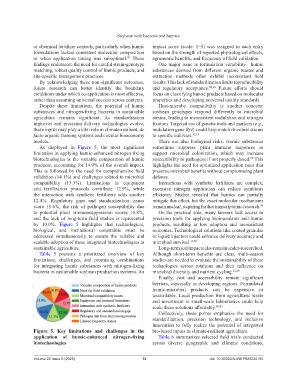
                  As  displayed in  Figure  5,  the  most  significant   sometimes suppress plant immune responses to
                limitation in applying humic-enhanced nitrogen-fixing   support  microbial  colonization,  which  may  increase
                biotechnologies  is the  variable  composition  of humic   susceptibility to pathogens if not properly dosed.  This
                                                                                                               85
                products, accounting for 14.9% of the overall impact.   highlights the need for optimized application rates that
                This is followed by the need for comprehensive field   preserve microbial benefits without compromising plant
                validation (14.1%) and challenges related to microbial   defense.
                compatibility  (13.3%).  Limitations  in  equipment    Interactions  with  synthetic  fertilizers  are  complex;
                and  fertilization  protocols  contribute  12.9%,  while   excessive  nitrogen  application  can  reduce  symbiosis
                the  interaction  with  synthetic  fertilizers  adds  another   efficiency.  Studies  revealed  that  humics  can  partially
                12.4%.  Regulatory  gaps  and  standardization  issues   mitigate this effect, but the exact molecular mechanisms
                score  11.6%,  the  risk  of  pathogen  susceptibility  due   remain unclear, requiring further transcriptomic research. 86
                to  potential  plant  immunosuppression  scores  10.8%,   On the practical side, many farmers lack access to
                and  the  lack  of  long-term  field  studies  is  represented   precision tools for applying bioinoculants  and humic
                by  10.0%.  Figure  5 highlights  that  technological,   products,  resulting  in  low  adoption  and  inconsistent
                biological,  and institutional constraints  must be   outcomes. Technological solutions like coated granules
                addressed simultaneously to ensure the reliable  and   or liquid injectors could enhance delivery accuracy and
                scalable adoption of these integrated biotechnologies in   microbial survival. 76,88
                sustainable agriculture.                               Long-term soil impacts also remain under-researched.
                  Table  5  presents  a  prioritized  overview  of  key   Although  short-term  benefits  are  clear,  multi-season
                limitations,  challenges,  and promising combinations   studies are needed to evaluate the sustainability of these
                for  integrating  humic  substances  with  nitrogen-fixing   technologies  across  rotations  and  their  influence  on
                bacteria in sustainable soybean production systems. An   microbial diversity and nutrient cycling. 32,89
                                                                       Finally,  cost  and  accessibility  remain  significant
                                                                    barriers, especially in developing regions. Formulated
                                                                    humic-microbial  products  can  be  expensive  or
                                                                    unavailable. Local production from agricultural waste
                                                                    and investment in small-scale laboratories could help
                                                                    scale these solutions affordably. 60,85
                                                                       Collectively,  these  points  emphasize  the  need  for
                                                                    standardization,  precision  technology,  and  inclusive
                                                                    innovation  to  fully  realize  the  potential  of  integrated
                Figure  5. Key limitations and  challenges in the   bio-based inputs in climate-resilient agriculture.
                application  of  humic-enhanced  nitrogen-fixing       Table 6 summarizes selected field trials conducted
                biotechnologies                                     across diverse geographic and climatic  conditions,


                Volume 22 Issue 6 (2025)                        13                           doi: 10.36922/AJWEP025230190

