


Page 91 - AJWEP-22-6
P. 91
ML-based C  for side trapezoidal labyrinth weirs
                                                         d
                              A                                      B


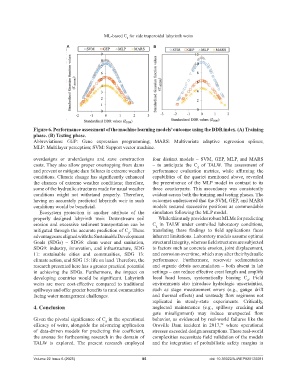
                Figure 6. Performance assessment of the machine learning models’ outcome using the DDR index. (A) Training
                phase. (B) Testing phase.
                Abbreviations:  GEP:  Gene  expression  programming;  MARS:  Multivariate  adaptive  regression  splines;
                MLP: Multilayer perception; SVM: Support vector machine.


                overdesigns or underdesigns and save construction   four distinct  models  – SVM, GEP, MLP,  and  MARS
                costs. They also allow proper overtopping from dams   –  to  anticipate  the  C   of  TALW.  The  assessment  of
                                                                                        d
                and prevent or mitigate dam failures in extreme weather   performance  evaluation  metrics,  while  affirming  the
                conditions. Climate change has significantly enhanced   capabilities  of  the  quartet  mentioned  above,  revealed
                the chances of extreme weather conditions; therefore,   the preeminence of the MLP model in contrast to its
                some of the hydraulic structures made for usual weather   three  counterparts.  This ascendancy  was consistently
                conditions  might  not  withstand  properly.  Therefore,   evident across both the training and testing phases. The
                having an accurately predicted labyrinth weir in such   outcomes underscored that the SVM, GEP, and MARS
                conditions would be beneficial.                     models secured successive positions as commendable
                  Ecosystem  protection  is  another  attribute  of  the   simulators following the MLP model.
                properly  designed  labyrinth  weir.  Downstream  soil   While this study provides robust MLMs for predicting
                erosion  and  excessive  sediment  transportation  can  be   C   in  TALW  under  controlled  laboratory  conditions,
                                                                      d
                mitigated through the accurate prediction of C . These   translating  these  findings  to  field  applications  faces
                                                         d
                advantages are aligned with the Sustainable Development   inherent limitations. Laboratory models assume optimal
                Goals (SDGs) – SDG6: clean  water and sanitation,   structural integrity, whereas field structures are subjected
                SDG9:  industry, innovation, and infrastructure, SDG   to factors such as concrete erosion, joint displacement,
                11:  sustainable  cities  and  communities,  SDG  13:   and corrosion over time, which may alter their hydraulic
                climate action, and SDG 15: life on land. Therefore, the   performance.  Furthermore,  reservoir  sedimentation
                research presented here has a greater practical potential   and organic debris accumulation – both absent in lab
                in  achieving  the  SDGs.  Furthermore,  the  impact  on   settings – can reduce effective crest length and amplify
                developing  countries  would  be  significant.  Labyrinth   local  head  losses,  systematically  biasing  C .  Field
                                                                                                              d
                weirs  are  more  cost-effective  compared  to  traditional   environments also introduce hydrologic uncertainties,
                spillways and offer greater benefits to rural communities   such as  stage  measurement  errors  (e.g.,  gauge  drift
                facing water management challenges.                 and  thermal  effects)  and  unsteady  flow  regimens  not
                                                                    replicated  in  steady-state  experiments.  Critically,
                4. Conclusion                                       neglected  maintenance  (e.g., spillway cracking  and
                                                                    gate  misalignment)  may  induce  unexpected  flow
                Given the pivotal significance of C  in the operational   behavior, as evidenced by real-world failures like the
                                               d
                efficacy of weirs, alongside the advancing application   Oroville Dam incident  in 2017,  where operational
                                                                                                  52
                of  data-driven  models  for  predicting  this  coefficient,   stresses exceeded design assumptions. These real-world
                the avenue for forthcoming research in the domain of   complexities necessitate field validation of the models
                TALW is explored.  The present research  employed   and  the  integration  of  probabilistic  safety  margins  in


                Volume 22 Issue 6 (2025)                        85                           doi: 10.36922/AJWEP025120081

