


Page 95 - AN-2-2
P. 95
Advanced Neurology                                                        Brain AT -R and kidney crosstalk
                                                                                            1

            by a hypersodic diet, as expected [33,47,48] . Our experimental   The decreased urinary osmolarity and creatinine
            design allowed independent evaluation of water and sodium   excretion concomitant with increased urinary volume
            intake, representing an advantage over protocols where the   induced by a hypersodic diet revealed the AVP role over
            sodium is administered through drinking water.     renal function. This is also supported by the effects induced
              In accordance with other authors, we found that 6 days   by renal denervation. Moreover, the ANG II role over AVP
            of hypersodic diet (4%) did not affect plasmatic sodium   becomes evident since the AT -R antagonist restores the
                                                                                        1
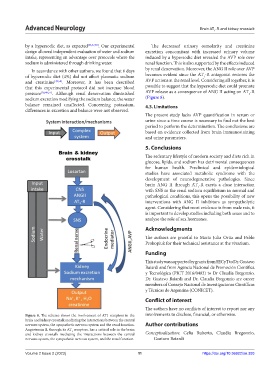
            and creatinine [49,50] . Moreover, it has been described   AVP actions at the renal level. Considering all together, it is
            that this experimental protocol did not increase blood   possible to suggest that the hypersodic diet could promote
            pressure [28,49,51] . Although renal denervation diminished   AVP release as a consequence of ANG II acting on AT -R
                                                                                                           1
            sodium excretion modifying the sodium balance, the water   (Figure 8).
            balance  remained  unaffected.  Concerning potassium,   4.3. Limitations
            differences in excretion and balance were not observed.
                                                               The present study lacks AVP quantification in serum or
                                                               urine since a time course is necessary to find out the best
                                                               period to perform the determination. The conclusions are
                                                               based on evidence collected from brain immunostaining
                                                               and urine parameters.
                                                               5. Conclusions

                                                               The sedentary lifestyle of modern society and diets rich in
                                                               glucose, lipids, and sodium has detrimental consequences
                                                               for  human  health.  Preclinical  and  epidemiological
                                                               studies have associated metabolic syndrome with the
                                                               development of neurodegenerative pathologies. Since
                                                               brain ANG II through AT -R exerts a close interaction
                                                                                     1
                                                               with SNS in the renal sodium equilibrium in normal and
                                                               pathological conditions, this opens the possibility of new
                                                               interventions with ANG  II inhibitors  as sympatholytic
                                                               agent. Considering that most evidence is from male rats, it
                                                               is important to develop studies including both sexes and to
                                                               analyze the role of sex hormones.

                                                               Acknowledgments
                                                               The authors are grateful to Maria Julia Ortiz and Pablo
                                                               Prokopiuk for their technical assistance at the vivarium.
                                                               Funding

                                                               This study was supported by grants from SECyT to Dr. Gustavo
                                                               Baiardi and from Agencia Nacional de Promoción Científica
                                                               y Tecnológica (PICT 2016/0403) to Dr Claudia Bregonzio.
                                                               Dr. Gustavo Baiardi and Dr. Claudia Bregonzio are career
                                                               members of Consejo Nacional de Investigaciones Científicas
                                                               y Técnicas de Argentina (CONICET).

                                                               Conflict of interest
                                                               The authors have no conflicts of interest to report nor any
            Figure 8. The scheme shows the involvement of AT1 receptors in the   involvements to disclose, financial, or otherwise.
            brain and kidney crosstalk mediating the interactions between the central
            nervous system, the sympathetic nervous system and the renal function.   Author contributions
            Angiotensin II, through its AT  receptors, has a critical role in the brain
                                1
            and kidney crosstalk mediating the interactions between the central   Conceptualization: Celia Ruberto, Claudia Bregonzio,
            nervous system, the sympathetic nervous system, and the renal function.  Gustavo Baiardi

            Volume 2 Issue 2 (2023)                         11                         https://doi.org/10.36922/an.393

