


Page 90 - AN-2-2
P. 90
Advanced Neurology                                                        Brain AT -R and kidney crosstalk
                                                                                            1

            decreased the number of Fos-IR cells (diet factor   factor F (1,15)  = 9.30, p < 0.05; treatment factor F (1,15)  = 0.32,
            F (1,14)   =  0.11, p = not significant (NS); treatment factor   p =  NS; interaction F (1,15)  = 0.41, p = NS) (Figure 5, right
            F (1,14)  = 4.81, p < 0.05; interaction F (1,14)  = 0.74, p = NS)   panel).
            (Figure 4, left panel).
                                                               3.2. c-Fos-AVP-IR expression
              PVN: In sham animals, no statistical differences were
            found in c-Fos expression in diet factor, treatment factor,   Hypersodic diet induced an increase in the number of
            or interaction between both factors (diet factor F (1,24)  = 0.04,   c-Fos-AVP-IR  cells  in SON,  and Los administration
            p = NS; treatment factor F (1,24)  = 0.001, p = NS; interaction   prevented it (diet factor F (1,4)  = 15.37, p < 0.05; treatment
            F (1,24)  = 0.30, p = NS). In the RDN group, Los decreased the   factor F (1,4)  = 6.94, p = NS; interaction F (1,4) =23.22, p < 0.01)
                                                               (Figure 6).
            number of c-Fos-IR cells in animals with the hypersodic
            diet)diet factor F (1,14)  = 0.71,  p =NS; treatment factor   3.3. Water, food, sodium, and potassium intake
            F (1,14)  = 5.63, p < 0.05; interaction F (1,14)  = 1.34, p =  NS)
            (Figure 4, right panel).                           As expected, the hypersodic diet increased the water
                                                               intake in sham animals, and Los prevented it (diet factor
              SFO: The diet or treatment did not affect c-Fos   F     = 6.03,  p < 0.05; treatment factor F   = 0.01,
                                                                (1,27)
                                                                                                    (1,27)
            expression in sham animals (diet factor F (1,25)  = 0.33,   p =  NS; interaction F   = 6.08, p < 0.05). In the RDN
                                                                                 (1,27)
            p  =  NS; treatment factor F (1,25)  = 0.19, p = NS; interaction   group, the hypersodic diet increased the water intake in the
            F (1,25)   =  0.01, p = NS). Although, in RDN animals, the   group treated with LOS (diet factor F   = 7.10, p <  0.05;
                                                                                             (1,20)
            hypersodic diet induced an increase in the number of   treatment factor F (1,20)  = 0.27  p = NS; and interaction
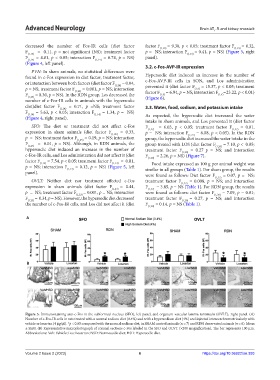
            c-Fos-IR cells, and Los administration did not affect it (diet   F    = 2.26, p = NS) (Figure 7).
            factor F (1,14)  = 7.54, p < 0.05; treatment factor F (1,14)   =  0.01,   (1,20)
                                                                 Food intake expressed as 100 g per animal weight was
            p = NS; interaction F (1,14)  = 0.12, p = NS) (Figure 5, left   similar in all groups (Table 1). For sham group, the results
            panel).
                                                               were found as follows: Diet factor F (1,27)  = 0.07, p =  NS;
              OVLT: Neither diet nor treatment affected c-Fos   treatment factor F (1,27)  = 0.008,  p = NS; and interaction
            expression in sham animals (diet factor F (1,23)   = 0.44,   F (1,27)   = 3.85, p = NS (Table 1). For RDN group, the results
            p  =  NS; treatment factor F (1,23)  = 0.001, p = NS; interaction   were found as follows: diet factor F (1,20)  = 7.09, p = 0.01;
            F (1,23)   =  0.34, p = NS). However, the hypersodic diet decreased   treatment  factor  F (1,20)  =  0.27,  p  =  NS;  and  interaction
            the number of c-Fos-IR cells, and Los did not affect it (diet   F (1,20)   = 0.14, p = NS (Table 1).


            A


            B


            Figure 5. Immunostaining anti-c-Fos in the subfornical nucleus (SFO), left panel, and organum vascular lamina terminalis (OVLT), right panel. (A)
            Number of c-Fos-IR cells in rats treated with a normal sodium diet (0.4%) and with a hypersodium diet (4%) and injected intracerebroventricularly with
            vehicle or losartan (4 µg/µl). *p < 0.05 compared with the normal sodium diet, in SHAM control animals (n = 7) and RDN denervated animals (n = 6). Mean
            ± SEM. (B) Representative microphotograph of coronal sections c-Fos labeled in the SFO and OLVT (×200 magnification). The bar represents 100 µm.
            Abbreviations: Veh: Vehicle; Los: Losartan; NSD: Normosodic diet; HSD: Hypersodic diet.


            Volume 2 Issue 2 (2023)                         6                          https://doi.org/10.36922/an.393

