


Page 89 - AN-2-2
P. 89
Advanced Neurology                                                        Brain AT -R and kidney crosstalk
                                                                                            1

            with diaminobenzidine hydrochloride, which produces   area (corresponding to ×200 magnification). Since nuclei
            a brown reaction product. Finally, they were mounted   size and section thickness did not change between the
            on gelatinized slides, air-dried overnight, dehydrated,   experimental and control groups, any systematic error
            cleared in xylene, and placed under a coverslip with DPX   could be identical for all groups. The counting was made
            mounting medium (Flucka Analytical).               by two operators on each section analyzed to ensure that
            2.7.2. Cytoarchitectural and quantitative analysis  the number of profiles obtained was similar, but only
                                                               one counting was used. Counting of c-Fos-IR and c-Fos-
            Images containing c-Fos-IR nuclei and c-Fos-AVP-IR were   AVP-IR cells was performed blinded to the observer.
            obtained using a computerized system that included a
            Leica DM 4000B microscope equipped with a DFC Leica   2.8. Statistical analysis
            digital camera attached to a contrast enhancement device.   The  experiments  were  designed  to  evaluate  the  brain
            The brain nuclei evidencing c-Fos-IR were identified and   AT -R  role in  renal function  through  SNS  under  two
                                                                 1
            delimited according to the atlas of Paxinos and Watson .   independent conditions: sham or renal denervation. The
                                                        [26]
            The numbers of c-Fos-IR nuclear profiles in the sections   data were reported as mean ± SEM and analyzed using
            were counted at a tone level; the distance from the bregma of   two-way ANOVA considering the following factors: Diet
            the corresponding plates is as follows: for the dorsomedial   (normosodic/hypersodic) and treatment (Los/vehicle)
            region of PVN = −0.92 mm, SON = −1.30 mm, SFO and   followed by  post hoc analysis Student-Newman Keuls in
            OVLT = −1.40 mm. The number of c-Fos-AVP-IR neurons   each condition. p < 0.05 was considered significant. The
            was counted in SON = −1.30 mm. The image analysis was   analyses were performed by using GraphPad Prism  6.03
                                                                                                         ®
            accomplished using ImageJ software from the National   software.
            Institutes of Health (NIH). The threshold was fixed
            between intervals of 0–150 in black-and-white conditions;   3. Results
            all higher values were considered background. C-Fos-IR
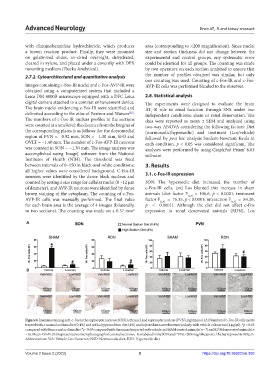
            neurons were identified by the dense black nucleus and   3.1. c-Fos-IR expression
            counted by setting a size range for cellular nuclei (8 –12 µm   SON: The hypersodic diet increased the number of
            of diameter), and AVP-IR neurons were identified by dense   c-Fos-IR cells, and Los blunted this increase in sham
            brown staining of the cytoplasm. The counting of c-Fos-  animals (diet factor F (1,9)  = 106.6,  p < 0.0001; treatment
            AVP-IR cells was manually performed. The final value   factor F (1,9)   =  76.35, p < 0.0001; interaction F (1,9)   =  84.20,
            for each brain area is the average of 4 images (bilaterally,   p   <   0.0001). Although the diet did not affect c-Fos
            in two sections). The counting was made on a 0.37 mm    expression in renal denervated animals (RDN), Los
                                                          2
            A


            B


            Figure 4. Immunostaining anti-c-Fos in the supraoptic nucleus (SON), left panel, and supraoptic nucleus (PVN), right panel. (A) Number of c-Fos-IR cells in rats
            treated with a normal sodium diet (0.4%) and with a hypersodium diet (4%) and injected intracerebroventricularly with vehicle or losartan (4 µg/µl). *p < 0.05
            compared with the normal sodium diet. p < 0.05 compared with the animals injected with vehicle, in SHAM control animals (n = 7) and RDN denervated animals (n
                                    #
            = 6). Mean ± SEM. (B) Representative microphotograph of coronal sections c-Fos labeled in the SON and PVN (×200 magnification). The bar represents 100 µm.
            Abbreviations: Veh: Vehicle; Los: Losartan; NSD: Normosodic diet; HSD: Hypersodic diet.

            Volume 2 Issue 2 (2023)                         5                          https://doi.org/10.36922/an.393

