


Page 115 - AN-3-3
P. 115
Advanced Neurology                                                   Evaluating plausibility of thalamic model


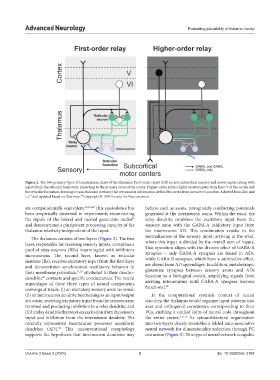
            Figure 1. The two primary types of transmission relays of the thalamus. First-order relays (left) receive subcortical sensory and motor inputs, along with
            inputs from the reticular formation, projecting to the primary areas of the cortex. Higher-order relays (right) receive inputs from layer V of the cortex and
            the reticular formation, forming a trans-thalamic pathway that retransmits information within the cortex from one area to another. Adapted from Zhu and
            Lo  and updated based on Sherman.  Copyright © 1999 Society for Neuroscience.
                                   24
             27
            are computationally equivalent. 16,19,28  This equivalence has   behave such as axons, retrogradely conducting potentials
            been empirically observed in experiments reconnecting   generated at the interneuron soma. Within the triad, the
            the inputs  of the lateral and medial geniculate nuclei    relay dendrite combines the excitatory input from the
                                                         29
            and demonstrates a pluripotent processing capacity of the   sensory  axon  with  the  GABA-A  inhibitory  input  from
            thalamus relatively independent of the input.      the interneuron AD. This combination results in the
              The thalamus consists of two layers (Figure 2). The first   normalization of the sensory input, arriving at the triad,
            layer, responsible for receiving sensory inputs, comprises a   where this input is divided by the overall sum of inputs.
            pool of relay neurons (REs) intermingled with inhibitory   This operation aligns with the divisive effect of GABA-A
            interneurons. The  second  layer, known as  reticular   synapses – only GABA-A synapses are found in ADs,
            neurons (Rs), receives excitatory input from the first layer   while GABA-B synapses, which have a subtractive effect,
            and demonstrates synchronized oscillatory behavior in   are absent from AD appendages. In addition, metabotropic
            their membrane potentials, 22,30  attributed to their dendro-  glutamate synapses between sensory axons and ADs
            dendritic  contacts and specific conductances. The neural   function as a biological switch, amplifying signals from
                   31
            appendages of these three types of neural components   arriving interneurons until GABA-A synapses become
                                                                        32
            converge at triads: (i) an excitatory sensory axon terminal;   functional.
            (ii) an interneuron dendrite functioning as an input/output   In the computational systemic context of neural
            structure, receiving excitatory input from the sensory axon   circuitry, the thalamus would organize input patterns into
            terminal and producing inhibition in a relay dendrite; and   axes and orthogonal coordinates corresponding to their
            (iii) a relay dendrite that receives excitation from the sensory   PCs, enabling a unified form of neural code throughout
            input and inhibition from the interneuron dendrite. The   the entire cortex. 8,11,12  Its cytoarchitectural organization
            centrally represented interneuron possesses axoniform   into two layers closely resembles a folded auto-associative
            dendrites (AD).  This unconventional morphology    neural network for dimensionality reduction through PC
                          32
            supports the hypothesis that interneuron dendrites may   extraction (Figure 3). This type of neural network is capable


            Volume 3 Issue 3 (2024)                         3                                doi: 10.36922/an.3188

