


Page 120 - AN-3-3
P. 120
Advanced Neurology                                                   Evaluating plausibility of thalamic model


                                         A


                                         B


                                         C


                                           D                                           E


                         J


                                           F                                           G


                                         H


                                          I


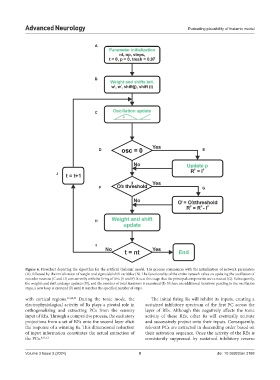
            Figure 6. Flowchart depicting the algorithm for the artificial thalamic model. The process commences with the initialization of network parameters
            (A), followed by the initialization of weight and sigmoidal shift variables (B). The functionality of the entire network relies on updating the oscillation of
            reticular neurons (C and D) concurrently with the firing of REs (E and F). It is at this stage that the principal components are extracted (G). Subsequently,
            the weights and shift undergo updates (H), and the number of total iterations is examined (I). If there are additional iterations pending in the oscillation
            steps, a new loop is executed (J) until it matches the specified number of steps.

            with  cortical  regions. 16,28,51   During  the  tonic  mode,  the   The initial firing Rs will inhibit its inputs, creating a
            electrophysiological activity of Rs plays a pivotal role in   sustained inhibitory spectrum of the first PC across the
            orthogonalizing and extracting PCs from the sensory   layer of REs. Although this negatively affects the tonic
            input of REs. Through a competitive process, the excitatory   activity of these REs, other Rs will eventually activate
            projections from a set of REs onto the second layer elicit   and successively project onto their inputs. Consequently,
            the response of a winning Rs. This dimensional reduction   relevant PCs are extracted in descending order based on
            of input information constitutes the actual extraction of   their activation sequence. Once the activity of the REs is
            the PCs. 8,11,12                                   consistently suppressed by sustained inhibitory reverse


            Volume 3 Issue 3 (2024)                         8                                doi: 10.36922/an.3188

