


Page 121 - AN-3-3
P. 121
Advanced Neurology                                                   Evaluating plausibility of thalamic model


            connections of the Rs for approximately 100 ms, the burst   It is worth noting that in the experimental setup of
            firing mode of these neurons will be triggered. These   Kim and McCormick,   O  represents the artificial input
                                                                                    j
                                                                                 12
            components will be relayed to the cortex in burst mode,   applied to the Rs. The sustained inhibition effect over time,
            where they will be integrated into neuron populations that   as indicated by the  prolonged tails  of the Rs  responses
            are hierarchically more abstract. 8,53,54          in  Figure  6, was modeled using the following function
              Therefore, the modulation and shaping of the     (Equation VIII):
            reticular activity are crucial for determining the order   y   x   1  e  x            (VIII)
                                                                    log
                                                                        2
            of PC extraction, and their sequence of activation plays
            a key role in encoding thalamic input properly into
            the cortex. Demonstrating that the activity of these   Where y corresponds to the response of the Rs (mV)
            artificial neurons mirrors electrophysiological findings   and x to time (ms).
            is a fundamental step in validating the system. One   Across all tested frequencies, we observed consistent
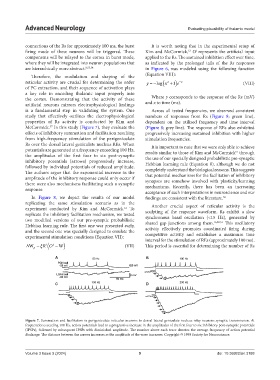
            study  that  effectively  outlines  the  electrophysiological   numbers of responses from Rs (Figure  8; green line),
            properties  of Rs  activity  is conducted  by Kim  and   dependent on the utilized frequency and time interval
            McCormick.  In this study (Figure 7), they evaluate the   (Figure 8; grey line). The response of REs also exhibited
                      57
            effects of inhibitory summation and facilitation resulting   progressively increasing sustained inhibition with higher
            from high-frequency stimulation of the perigeniculate   stimulation frequencies.
            Rs over the dorsal lateral geniculate nucleus REs. When   It is important to note that we were only able to achieve
            potentials are generated at a frequency exceeding 100 Hz,   results similar to those of Kim and McCormick  through
                                                                                                     57
            the amplitudes of the first four to six post-synaptic   the use of our specially designed probabilistic pre-synaptic
            inhibitory  potentials (arrows) progressively increase,   Hebbian learning rule (Equation 8), although we do not
            followed by individual potentials of reduced amplitude.   completely understand the biological reasons. This suggests
            The authors argue that the exponential increase in the   that potential mechanisms for the facilitation of inhibitory
            amplitude of the inhibitory response could only occur if   synapses are somehow involved with plasticity/learning
            there were also mechanisms facilitating such a synaptic   mechanisms. Recently, there has been an increasing
            response.
                                                               acceptance of such interpretations in neuroscience and our
              In  Figure  8, we depict the results of our model   findings are consistent with the literature. 58
            replicating the same stimulation scenario as in the   Another crucial aspect of reticular activity is the
            experiment conducted by Kim and McCormick.   To    sculpting  of the  response waveform.  Rs  exhibit a  slow
                                                      12
            replicate the inhibitory facilitation mechanism, we tested   synchronous basal oscillation (<15  Hz), generated by
            two modified versions of our pre-synaptic probabilistic   shared gap junctions among them. 16,28,51  This oscillatory
            Hebbian learning rule. The first one was presented early,   activity effectively promotes coordinated firing during
            and the second one was specially designed to emulate the   competitive  activity  and establishes a  maximum  time
            experimental stimulation conditions (Equation VII):  interval for the stimulation of REs (approximately 100 ms).

                        j
                    i
            W   RO    W                          (VII)    This period is essential for determining the number of Rs
               ji
                         A                                     B


                         C                                     D


            Figure 7. Summation and facilitation in perigeniculate reticular neurons to dorsal lateral geniculate nucleus relay neurons synaptic transmission. At
            frequencies exceeding 100 Hz, action potentials lead to a progressive increase in the amplitudes of the first four to six inhibitory post-synaptic potentials
            (IPSPs), followed by subsequent IPSPs with diminished amplitude. The number above each trace denotes the average frequency of action potential
            discharge. The distance between the arrows increases as the amplitude of the wave increases. Copyright © 1999 Society for Neuroscience.


            Volume 3 Issue 3 (2024)                         9                                doi: 10.36922/an.3188

